
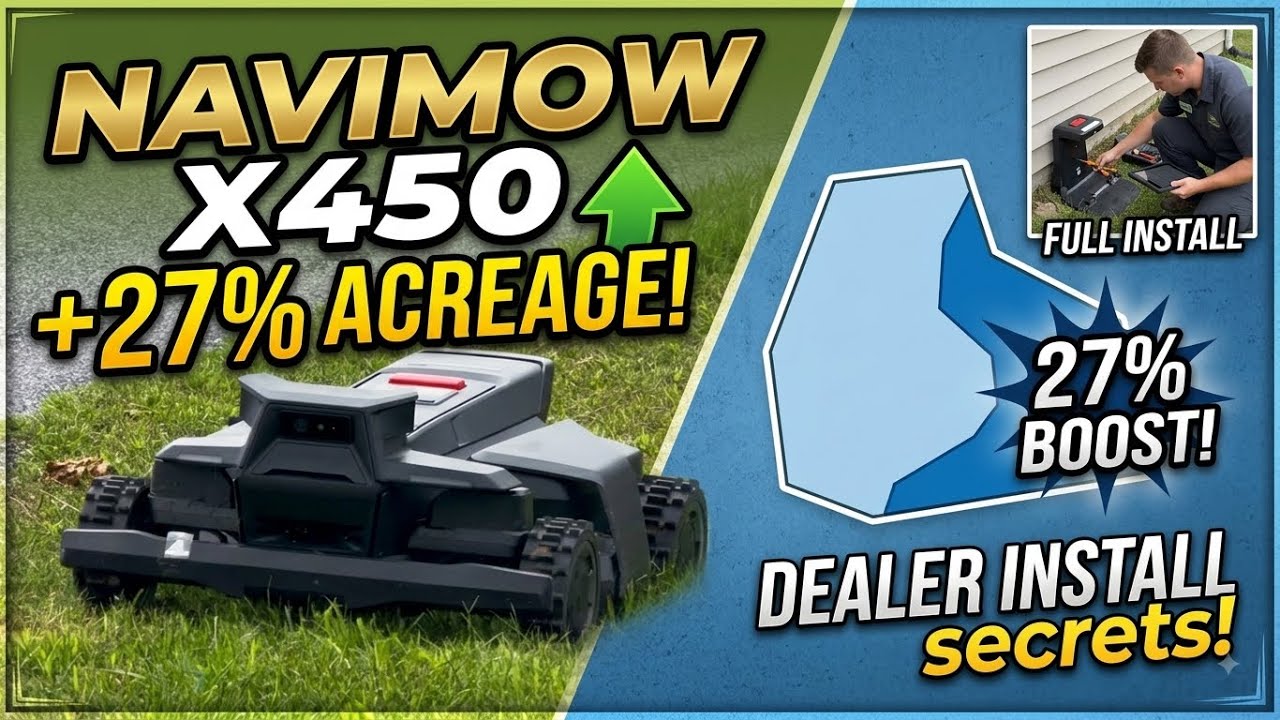
Navimow X450 on a 1.82-Acre Maryland Farm: Why We Split the Zones

Most robot mower installs are a boundary, a cutting height and a schedule. This one wasn’t.
The property is a working farm outside Baltimore, Maryland: 1.82 acres of mapped lawn, a hill steep enough to respect, a drainage ditch running through the middle of it, and one awkward L-shaped area that would have quietly cost the owner runtime for years if we’d left it as drawn.
Three decisions made this install work, and none of them appear in the manual. All three take a couple of minutes in the app. You can copy every one of them on your own lawn.
The property, in numbers
| Mapped lawn | 1.82 acres |
| Mower | Segway Navimow X450 — rated 1.5 acres |
| Cutting deck | 17” dual-disc |
| Slope rating | 84% (about 40°) |
| Zones | Front yard, side yard, plus the split pair |
| No-go zones | Drainage ditch, with a buffer on both shoulders |
| Dock | On a 3’ × 5’ rubber mat, outside the cut area |
Why split an L-shaped zone into two rectangles?
Because a robot mower cuts in straight parallel lines, and an L-shape breaks most of them in half.
Give an RTK mower a clean rectangle and it does genuinely beautiful work: a long pass end to end, one tidy turn at the boundary, the next pass, repeat. Efficient, even, predictable.
Give it an L and the geometry starts fighting. The lines get planned across the whole zone, so every pass that runs through the short leg has to stop early, pivot, reposition and carry on. Some passes are full length. Plenty are a third of that. The ratio of turning to cutting goes up, and you pay for it three ways:
- Runtime. Turning isn’t mowing. Every pivot is battery spent repositioning instead of cutting. Over a big zone that’s the difference between finishing on one charge and coming back for a second.
- Cut quality. Pivot points are where drive wheels scuff turf. You’ll notice it most in spring, when the ground is soft and the grass is growing fast enough to show every mark.
- Wear. Wheel gears, drive motors and tires all take loads during a turn that a straight pass never puts on them. A mower doing thousands of extra pivots a season ages like one.
The fix: open the map, tap the zone, hit Edit, and draw a split line across the elbow of the L. Two rectangles instead of one L. The mower still cuts the same square footage — it just stops spending so much of the job turning around.
Where do you draw the split line?
Find the point where the shape changes direction. That inside corner is almost always the line. Two obvious legs, two zones. Three legs, three zones.
Then stop. Don’t over-split. Every zone boundary is somewhere the mower has to travel between, and chopping one honest rectangle into four pieces invents a different inefficiency. Split where the geometry actually bends, not everywhere you could.
Should you use all six mowing directions, or pick one?
The X4 series gives you six mowing directions per zone — labelled A through F, set under Edit → Mowing direction, with an “optimal angle” marker as a starting suggestion. Most owners set it once and never look again. Depending on the zone, that’s either leaving lawn health on the table or leaving runtime on the table.
On open, roughly square zones: rotate through several
Select multiple directions and let the mower cycle them.
Mowing the identical line every single time does two unhelpful things. The wheels track the same path over and over, compacting soil into narrow lanes — on the clay-heavy soil across the Mid-Atlantic that shows up as visible wear lines by midsummer. And the grass learns to lie over one way, which is exactly why sports turf crews change their pattern every cut.
Rotating directions spreads the wheel traffic and keeps the blades standing up. It costs nothing: the mower isn’t working harder, it’s just starting from a different angle. (It’s the same principle behind making stripes with a robot mower, used for turf health instead of looks.)
On long narrow zones: lock one direction and leave it
Now flip it. Say you have a strip along a driveway — 200 ft long, 25 ft wide, 5,000 sq ft of grass. With a 17-inch deck, here’s what direction choice actually costs:
| Lines run the long way | Lines run the short way | |
|---|---|---|
| Passes to cover the strip | ~18 | ~141 |
| Length of each pass | 200 ft | 25 ft |
| Turns per full cut | ~17 | ~140 |
| Grass cut | 5,000 sq ft | 5,000 sq ft |
Same strip, same total cutting distance, about eight times the turning. (Rounded from 5,000 sq ft and a 17” deck before overlap — your mower’s real numbers will land near these, not on them.) At a couple of seconds a pivot, that’s minutes of every single cut spent turning around, every cut, all season.
So on a strip, choose the direction parallel to the long axis and leave it alone. You give up the pattern rotation, but a 25-foot-wide strip doesn’t have room for compaction lanes to matter much anyway — and you get the runtime back many times over.
As for that “optimal angle” marker: it’s a reasonable default, and it’s reading the shape of your zone and nothing else. It doesn’t know about the hill, the ditch, or which way you’d rather the lines run when you’re looking at the yard from the kitchen window.
Why does the charging station sit on a rubber mat?
Because the dock’s footprint is grass the mower can never cut, and nobody warns you about it until you’re living with it.
The station occupies real space. The mower can’t cut underneath it, and it can’t cut the ring right around it either — the blade disc doesn’t extend to the edge of the chassis, and the mower needs clearance to dock cleanly. So you get a little island of shaggy grass around the dock for the whole season, and every few weeks you’re out there with a string trimmer, tidying up around the machine you bought so you’d stop doing that.
On this farm we set the station on a 3’ × 5’ rubber stall mat. That solves three problems at once:
- The dock now lives outside the mowing area. No grass under it, no ring around it, nothing to trim.
- It gets a level, stable base. Stations set straight on soil settle unevenly over a season — especially after a wet Maryland spring — and a dock that has tilted is a dock that throws docking errors.
- The contacts stay cleaner. The mower stops dragging wet clippings and mud onto the charging pins every time it comes home.
A stall mat from a farm supply store runs about $30–50 and weighs enough that it stays put. Pick a flat spot near your power source, set the station on it, map the boundary so the mat sits just outside the cut area, and you’re done.
One thing to check before you commit to the spot: the dock still needs open sky above it. The mower has to establish its satellite fix at the station before it starts a job, and a tucked-away corner under a deck or a dense tree will stop the job before it begins — a lesson from a Warrington, PA install where the pretty spot cost us an afternoon. The RTK antenna’s sky view is a separate decision from the dock’s, and both have to be right.
Small detail. It’s also the one customers thank us for six months later.
How do you set up a zone on a steep hill?
The hill here is steep enough to be a real factor. The X450 is rated to 84% (roughly 40°) and it handles this one — but on a slope, mowing direction stops being an efficiency question and becomes a traction question.
Running the lines across the face of a slope rather than straight up and down gives the drive wheels better purchase and cuts the chance of the machine sliding as it pivots. That’s the opposite of the “rotate through all six” advice for flat, open ground: on a hillside zone, one direction, chosen deliberately, and don’t rotate it for the sake of pattern.
If a slope is the defining feature of your property rather than one corner of it, we go deeper in our guide to robot mowers on hilly yards.
What about the ditch?
We mapped it out entirely, with a comfortable buffer on both shoulders.
Robot mowers are good at a great many things, and a drainage ditch with soft wet shoulders is not the place to discover where the limit is. A no-go zone costs nothing to draw and can be edited from a phone if the owner ever regrades it. The owner trims that edge a few times a season, and never has to pull a 64-pound machine out of standing water. That’s a fair trade, and it’s the same call we make around ponds, drop-offs and creek banks on every install.
1.82 acres on a 1.5-acre rating
Worth noting, because the spec sheet says 1.5 and this map says 1.82: the coverage ratings on robotic mowers are conservative by design. Manufacturers size them for average conditions — awkward zone shapes, a dock wherever the outlet happened to be, mediocre satellite reception. Optimize all three and there’s often real headroom in the machine. Our Lewes, Delaware install runs 1.91 acres on the same mower for exactly the same reasons.
The honest caveat is the same one we gave there: that headroom is property-specific. An open lawn with a clean sky view has it. A shaded, chopped-up lot may have none of it, and we’d rather tell you that before the sale than after. Zone splitting is one of the levers that buys it — the turning you stop paying for is runtime you get back.
If you want to know what your own property supports, our free check-my-lawn tool measures your real mowable area and sky view from satellite in about two minutes.
The short version
- Put the charging station on a mat, outside the cut area — and make sure that spot still has open sky.
- Split L-shaped zones into rectangles at the inside corner. Don’t over-split.
- Rotate directions on open zones; lock one direction on narrow strips and on slopes.
- Map generous buffers around ditches, water and drop-offs.
None of it is difficult. Together, over a full season, it’s the difference between a mower that finishes its schedule and one that’s always a little behind.
Get your lawn mapped
Zippy Lawnz is an authorized Segway Navimow, Mammotion and Yarbo dealer, installer and service center covering Pennsylvania, New Jersey, Maryland, Delaware, Virginia and Colorado. We handle professional installation, boundary mapping and zone design, warranty service, and we stock mowers, blades and accessories — so when you need a blade set or a wheel, you’re not waiting on a shipment.
- 📍 Check my lawn — free — real mowable square footage, sky view and a mower match in about two minutes.
- 🗺️ Book a free site assessment — we’ll pull up your address and plan the zones before anything is bought.
- 🤝 Your local Maryland dealer page — sales, install and service across Anne Arundel, Baltimore and Howard counties.
📞 410-725-7500 · ✉️ [email protected]
Installed: Segway Navimow X450 · Location: working farm outside Baltimore, Maryland · Mapped: 1.82 acres on a 1.5-acre rating
Frequently asked
Should you split an L-shaped robot mower zone into two rectangles?
Yes, on almost every L-shaped lawn. A robot mower plans systematic parallel lines across the whole zone, so in an L the passes that run through the short leg stop early, turn, reposition and continue — you get a mix of full-length passes and stub passes, and the ratio of turning to cutting climbs. Split the zone at the inside corner and both halves become rectangles the mower can run end to end. Same grass, same total area, a fraction of the turning: less battery spent repositioning, fewer pivot points scuffing turf, less load on the drive motors. It takes about a minute in the Navimow app under Edit.
What mowing direction should a robot mower use on a long narrow strip of lawn?
Pick the direction that runs parallel to the long axis and leave it there. On a 200 ft × 25 ft strip along a driveway, a 17-inch cutting deck needs roughly 18 passes to cover it lengthwise (about 17 turns) but roughly 141 passes crosswise (about 140 turns) — same grass, same cutting distance, eight times the turning. Direction rotation is worth giving up on a strip that narrow, because there isn't enough width for wheel ruts to matter much anyway. On open, roughly square zones, do the opposite: select several directions and let the mower rotate through them.
Should a robot mower charging station sit directly on the grass?
We'd rather it didn't. The dock's footprint can't be mowed, and neither can the ring of grass right around it — the blade disc doesn't reach the edge of the chassis and the mower needs clearance to dock cleanly — so you inherit a patch of string-trimmer work all season around the machine you bought to end string-trimmer work. Setting the station on a 3 ft × 5 ft rubber stall mat (about $30–50 at a farm supply store) puts it outside the cut area, gives it a level base that won't settle unevenly after a wet spring, and keeps wet clippings and mud off the charging contacts. Map the boundary so the mat sits just outside the mowing area — and make sure the spot still has open sky above the dock, because the mower needs a satellite fix before it leaves.
Can a Navimow X450 mow 1.8 acres?
On the right property, yes — this Maryland farm maps at 1.82 acres on a mower rated for 1.5, and our Lewes, Delaware install runs 1.91. The rating is deliberately conservative because it has to assume average conditions: awkward zones, a dock wherever the outlet happens to be, and an unhelpful sky view. Fix those three things and there is usually headroom. It is property-specific, not a promise — a shaded, chopped-up lot may have none of it. Our free lawn check measures your real mowable area and sky view in about two minutes, and a site assessment answers whether the headroom is there.
Can a robot mower work around a drainage ditch?
It can work around one; we don't let it work in one. On this farm the ditch cutting through the middle of the property became a no-go zone with a generous buffer on both shoulders, because a wet, soft-shouldered bank is exactly where an otherwise capable mower finds its limit — and a stuck mower in standing water is a bad afternoon and a worse repair. The homeowner trims that edge a few times a season. That's the trade: a few minutes of hand work in exchange for never fishing a 64-pound machine out of a ditch.
Do you install robotic mowers in Maryland?
Yes — Baltimore County, Anne Arundel, Howard, Carroll, Harford and the Eastern Shore, along with Pennsylvania, New Jersey, Delaware, Virginia and Colorado. Zippy Lawnz is an authorized Segway Navimow, Mammotion and Yarbo dealer and service center. A farm install like this one includes the site evaluation, RTK antenna placement, mapping and zone design, dock siting, no-go zones, owner training and local warranty service. Call or text 410-725-7500.
Keep reading
 Customer InstallsNavimow X450 on 1.9 Acres: A Lewes, DE Install Beyond the Spec SheetThe Segway Navimow X450 is rated for 1.5 acres. On this Lewes, Delaware install we mapped 1.91 — how dealer-grade RTK setup, zoning and dock placement did it.
 Customer InstallsNavimow X450 on a Virginia Farm: Gates, Paddocks, Tight PassagesCan a robot mower handle a working farm? We put the Navimow X450 on a Virginia farm — MowGate through fences, paddock zones, no-go zones and RTK + cellular.
 Customer InstallsNavimow X430 vs. Maryland's Steepest Lawn: Annapolis InstallThe steepest lawn we've ever installed on: gas crews tore up this hilly Annapolis, MD property for years. How an AWD Navimow X430 made it 100% autonomous.
Explore the system
The mowers and pages behind this topic — see them sized to your yard.