
Robot Mower Tips for Hilly Yards: 12 Ways to Win on Slopes

Hilly yards are where robot mowers beat gas equipment the hardest — a machine at a small fraction of the weight doesn’t rut, slide, or scalp the way hundreds of pounds of commercial mower does. But hills are also where a careless setup fails fastest. The video above is the steepest lawn we’ve ever installed on — two huge hills in Annapolis, MD that gas crews tore up for years — and these twelve tips are the exact playbook that made it work, from a dealer that installs and services slope machines every week.
If you’re still deciding whether a robot can hold your hill, start with do robot mowers work on slopes? — this guide is about doing it right.
1. Learn your slope’s real number before anything else
Guessing a grade by eye is unreliable — almost everyone overestimates flat and underestimates steep. Mower ratings are quoted in percent grade (rise over run), so get your yard’s actual number: our free lawn check estimates it from 3D elevation data in about two minutes and flags the steep sections. Every decision below — which machine, which zones, what gets excluded — flows from that number.
2. Buy all-wheel drive, with headroom above your steepest zone
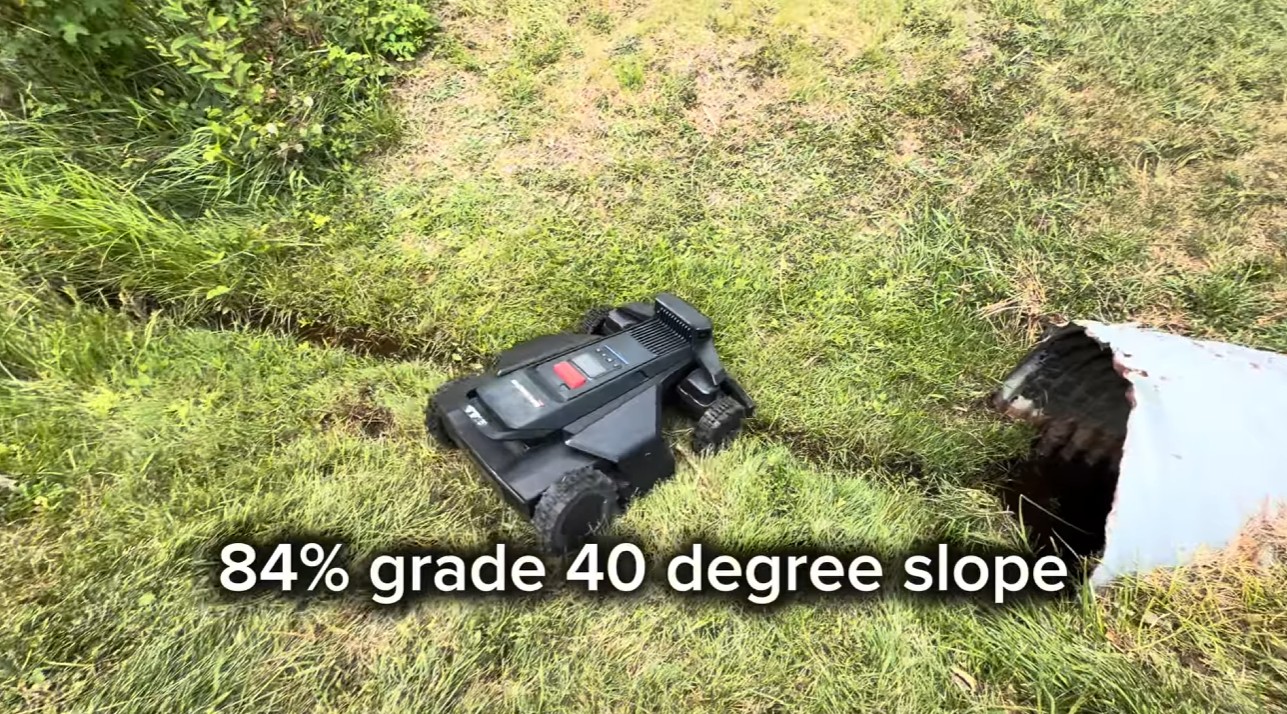
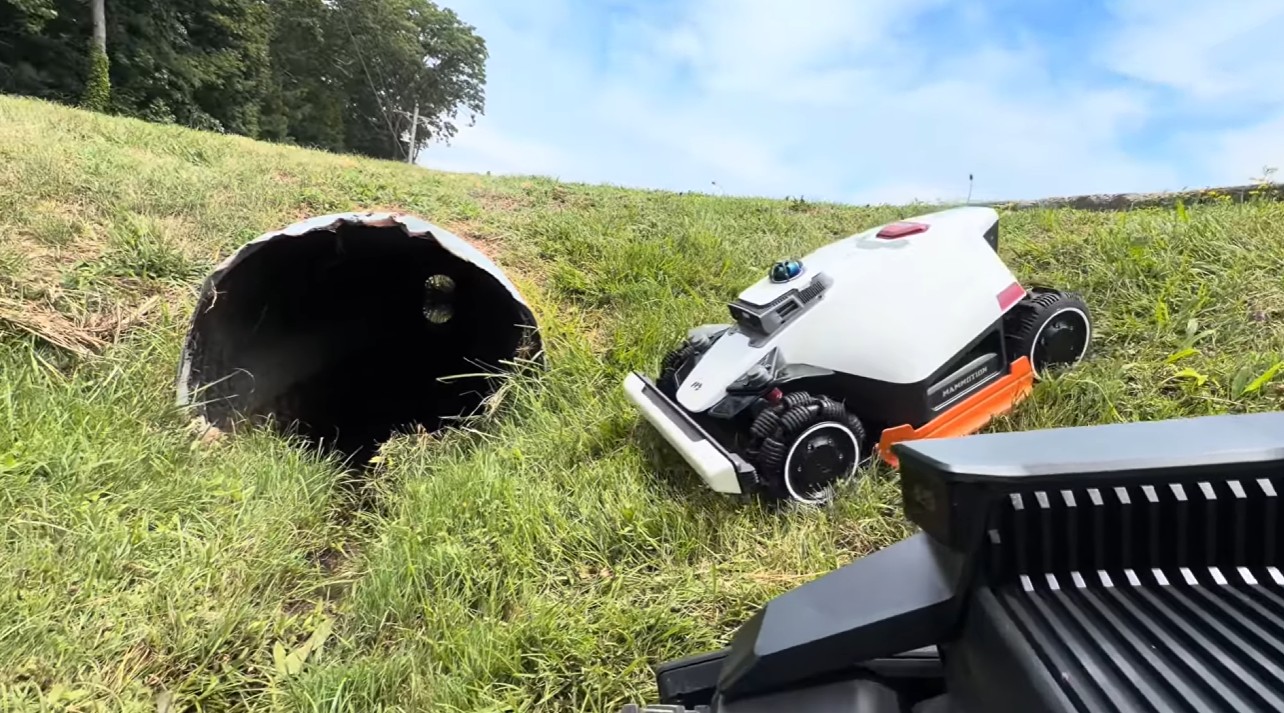
On anything beyond a gentle roll, two-wheel-drive robots spin out, slide sideways, and leave uncut streaks. Get AWD — and don’t buy a machine rated at your steepest slope, buy one rated comfortably past it, because ratings assume dry ground and good traction. The two machines that won our hills field test — the Segway Navimow X4 (84% grade) and Mammotion LUBA 3 AWD (80%) — both carry far more rating than almost any residential lawn needs. That margin is the point.
3. Size up — hills tax the battery
Climbing costs energy, so a hilly acre takes meaningfully more runtime than a flat one. A mower that covers its rated acreage on flat ground finishes less on the same acreage tilted, recharges more often, and falls behind in spring surges. Our rule on sloped properties: size for your steepest, wettest week, not your average one. (The battery math is worth understanding before you pick a size.)
4. Cut high — tall grass is your erosion control
Set the deck near the top of its range on slopes, around 3.5–4 inches where your model allows. Taller grass grows deeper roots that literally hold the hillside together, shades the soil so it keeps moisture in summer, and forms a dense mat the mower’s tires can grip. A scalped slope is a double failure: rain strips the exposed soil, and the slick thin turf robs the next pass of traction.
5. Mow often — light, frequent cuts hold a hill together
This is where robots have an unfair advantage: they can mow a little, every day. Frequent cuts remove millimeters at a time, feed the turf with micro-clippings, and thicken the lawn — which is both healthier grass and better grip for the machine. It’s the opposite of the weekly gas-crew cycle that stresses a slope with one heavy cut and a thousand pounds of equipment.
6. Time mowing for dry grass
Traction drops hard on wet or dewy grass, and even a slope-rated mower can slip below its rating on a damp bank. Schedule slope zones for late morning through evening, after dew burns off, and use the rain delay — most robots pause and let the lawn dry before resuming. (Contrary to instinct, overnight mowing is great for flat zones — just not for your steepest, dewiest ones.)
7. Exclude what the mower can’t hold — on purpose
Every hilly property has a worst spot. If a bank is past the machine’s real-world capability, the answer is not “try it and see” — it’s a precise exclusion zone, mapped so the robot works everything it can and never attempts what it can’t. On our Annapolis install, most zones were inside the X430’s capability, a few weren’t, and drawing that line honestly is what made the whole property dependable.
8. Convert what you exclude
An excluded bank doesn’t have to stay a chore. Replace the grass on unmowable patches with mulch, spreading ground cover, or hardscape — no grass, no mowing problem. That’s how a lawn with zones beyond any mower’s rating still ends up 100% autonomous: every square foot is either mowed by the robot or converted to a surface that never needs mowing again.
9. Dock on the flat, antenna in the open
Put the charging station on level ground with a flat, straight approach — docking on a grade wears the machine and causes missed connections. And on hilly lots, mind the sky: a slope itself can shadow satellite signal on its downhill face, so RTK antenna placement matters more than it does on flat ground. High and open beats convenient. On a Carlisle, PA install — an X430 taming a septic mound that’s steep on all four sides — that meant the antenna on the roof eave, the power supply on the wall, and the dock cables buried: the finished-install version of this tip, on video.
10. Give drop-offs a buffer
The bottom of a hill usually ends at something unforgiving — a retaining wall, a curb, a street, a ditch. Map those edges with a deliberate setback rather than running the boundary tight, and tune the edge behavior so the mower trims close on safe borders and stays back from the drops. It’s the difference between a mower that works the hill and one you fish out from below it once a season.
11. Keep the tread and blades in shape
Traction is a maintenance item. Knobby tires packed with clippings and mud grip like slicks — clear them when you clean the deck — and watch tread wear on machines that climb daily, because worn knobs show up as slipping long before they look bad. Keep the blades fresh too: sharp blades cut cleanly at tall heights, while dull ones push grass over and stress turf you’re trying to thicken.
12. Let a pro map the hard yards
Flat quarter-acre lots forgive a DIY setup. Hilly properties don’t — zone patterns, exclusion lines, connecting channels between hills, and edge behavior near drop-offs all have to be deliberate, and most mapping mistakes we fix trace back to slopes. A professional installation means someone who has watched these machines on dozens of hills decides what your terrain can support — and tells you honestly when part of it can’t. When even a flagship AWD machine isn’t enough, there’s an escalation path: on one Pennsylvania mountain property we stepped up to the commercial-grade Navimow Terranox.
Start with your hill’s actual numbers
The whole playbook starts with knowing your slope, your sky view, and your square footage — and that part is free. Check your lawn and we’ll estimate the grade from elevation data, flag the sections that need AWD (or an exclusion plan), and match machines that actually hold your hill. Then we confirm the steep spots together before you spend a dollar.
Call or Text Us: 410-725-7500 — hilly yards are our favorite problem, nationwide by phone and hands-on across PA, NJ, MD, DE, VA & CO.
Frequently asked
How often should a robot mower run on a hilly lawn?
Near-daily, or at least several times a week. Frequent light cuts are the single best habit on a slope: the mower removes a few millimeters at a time, the micro-clippings feed the turf, and the grass thickens into a dense mat whose roots hold the hillside together. Thicker turf also means better traction for the mower itself, so the schedule literally makes the machine more capable. Infrequent heavy cuts do the opposite — they stress the grass and leave loose clippings on ground that erosion is already working on.
What cutting height is best on a slope?
Run near the top of your mower's range — about 3.5 to 4 inches where the model allows it. Taller grass grows deeper roots, and on a hill those roots are your erosion control; taller turf also shades the soil, holds moisture through summer heat, and gives the mower's wheels a denser mat to grip. Scalped slopes fail twice: the thin turf lets water strip the soil, and the slick surface robs any mower of traction.
Should a robot mower mow up and down a hill or across it?
Modern AWD robots handle both, and their navigation plans the pattern for you — but the steepest pitches are best worked up-and-down rather than traversed. Side-hill passes on a steep grade are where machines slide, and where wheel-scrub tears turf on the turns. If a section is steep enough that you'd only feel safe pushing a mower straight up it, treat that as a sign to check the slope against the machine's rating — and to let the installer set the zone's pattern deliberately instead of leaving it to chance.
Do hills drain a robot mower's battery faster?
Yes. Climbing costs real energy, so a hilly acre takes meaningfully more runtime than a flat one — the mower finishes fewer square feet per charge and returns to the dock more often. That's why we size sloped properties with headroom instead of matching the coverage rating exactly: a machine rated near your acreage on flat ground can fall behind on the same acreage tilted. Buy the next size up and the hills stop being a scheduling problem.
What should I do with a bank that's too steep to mow?
Take it out of the mowing plan honestly. Map it as an exclusion zone so the robot never attempts it, then convert the surface so it doesn't need mowing at all — mulch, spreading ground cover like juniper or creeping sedum, or hardscape. No grass, no mowing problem. That's how our steepest install ever, in Annapolis, MD, ended up 100% autonomous: every square foot is either mowed by the robot or converted to a surface that never needs a mower again.
Keep reading
 Buying guideBest Robot Mower for Hills & Steep Slopes (2026 Field Test)We tested the two most capable slope machines head-to-head on real rough ground: Mammotion LUBA 3 AWD (80%) vs Navimow X4 (84%) — and which tears up your turf.
 How-toDo Robot Mowers Work on Slopes and Hills?Yes — modern all-wheel-drive robot mowers handle brutal slopes. We break down a field test where a robot climbs an 84% grade (40°) and clears 2-inch obstacles.
 Customer InstallsNavimow X430 vs. Maryland's Steepest Lawn: Annapolis InstallThe steepest lawn we've ever installed on: gas crews tore up this hilly Annapolis, MD property for years. How an AWD Navimow X430 made it 100% autonomous.
Explore the system
The mowers and pages behind this topic — see them sized to your yard.