
Can a Robot Mower Handle a 40% Slope? Bucks County X430 Install

If you’ve been told your property is “too steep” or “too complicated” for a robotic mower, this install is for you.
We recently completed what we’re calling a Complexity Level 10 installation in Bucks County, Pennsylvania — the steepest, most obstacle-dense property we’ve ever put a robot mower on. The customer built a massive berm, a man-made hillside that runs along the front of his property to shield the house from the road. It’s a beautiful piece of landscaping. It’s also a mowing nightmare: close to an acre of ground with 40%+ grades, steep downhill runs, and dozens of young trees and bushes planted directly on the slope.
Mowing this by hand means dragging equipment up and down a hill in the summer heat. A riding mower is a rollover risk at these angles. So the customer called us, and we brought the Segway Navimow X430.
What makes this a Complexity Level 10 property?
It maxes out all three things we assess: slope, obstacles and layout. Any one of them is manageable. All three on the same property is a genuine stress test.

- Slope. The berm’s steepest sections pass a 40% grade — about 22°. That’s beyond most entry-level robot mowers, which are rated for 30–45%, and it’s the kind of pitch where a riding mower stops being safe. The slope isn’t uniform either: it rolls and peaks, so the mower is constantly transitioning between climbing, descending and side-hilling.
- Obstacles. Scattered across that slope are dozens of trees and shrubs the customer planted. Each one is something the mower has to navigate around without scalping the mulch beds or missing the grass between them.
- Layout. At close to an acre of mapped mowing area, this isn’t a postage-stamp lawn. It demands multiple mowing zones with clean transitions between them, and a boundary along the road side that leaves nothing to chance.
Why the Navimow X430 for a 40% slope?
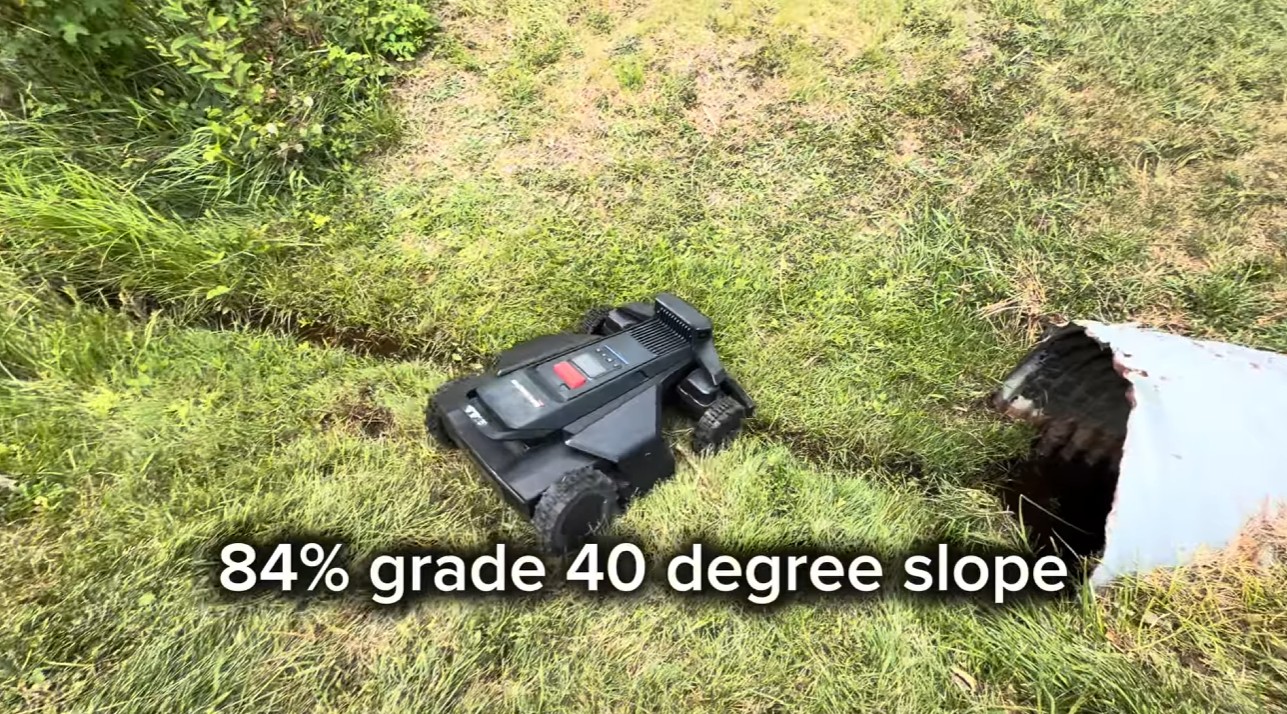
Because a 40% grade is a normal day for it, not a stunt. The X430 is rated for slopes up to 84% grade — roughly 40° — with four-wheel drive, Xero-Turn steering that pivots without dragging its wheels across the turf, and 2.8 inches of obstacle clearance. It pairs RTK positioning with onboard vision, so it holds a precise line on terrain where cheaper mowers lose their footing or their location fix. On a 40% grade, traction is everything — especially on the downhill runs, where a lighter two-wheel-drive mower can start to slide.
Two more reasons it fit this property:
- Capacity. The X430 is rated for lawns up to about an acre, and the Navimow app maps this property at just under one — right at the top of its rating, which is exactly where a dialed-in install matters. (For bigger hillsides, its sibling the X450 steps up to an acre and a half.)
- Multi-zone mapping. The X4 handles multiple zones and virtual channels well, which let us break the berm and the surrounding lawn into logical sections the mower works through on its own schedule.
The honest caveat we give every hillside customer: a slope rating assumes reasonable traction. Wet grass, thin turf and what’s at the bottom of the hill still decide the real-world limit — which is why we assess every zone against what we’ve watched the X4 platform actually do across dozens of installs, not just the spec sheet. (How steep is too steep? The full slope guide.)
How we installed it: local RTK, multiple zones, slope-aware boundaries
Steep, tree-covered properties are where professional installation earns its keep. Here’s what this one involved.

A local RTK base station. RTK is what gives the mower centimeter-level positioning. On an open lawn you can sometimes rely on network corrections, but on a property like this — elevation change, tree canopy, and a mower that absolutely cannot afford to wander near a road — a local base station is the right call. We mounted it with a clear sky view and ran the wiring with tidy, weather-protected cable management, because an install should look as good as it works. (NetRTK vs a local base station, explained.)
Multi-zone mapping. We mapped the property into multiple zones and channels, so the mower moves between areas deliberately instead of treating an acre of complicated terrain as one giant map. This improves coverage, makes scheduling smarter, and keeps mowing patterns efficient around the obstacle-heavy sections. Every tree and shrub on the slope became a precise no-go zone. (The mapping mistakes we see most, and how to avoid them.)
Slope-aware boundaries. On grades like this, where you draw the boundary matters. We set the maps so the mower approaches the steepest faces at the right angles and keeps safe margins near the road side of the berm.
So… did it survive?
Yes. Watch the video for the full run, but the short version: the X430 handled the berm. It climbed the steepest face, held its line on the side-hill passes, threaded the trees and bushes, and worked through the zones without a rescue mission. The customer now has an acre-class hillside — dangerous and miserable to mow by hand — that maintains itself, a little every day.
That daily cadence matters on a slope, too. Instead of one heavy machine shearing a week of growth off a wet bank, a light robot takes a sliver at a time, so the turf on the berm gets thicker and holds the hill better with every season. (Why little-and-often mowing grows a stronger lawn.)
How steep is too steep for a robot mower?
A 40% grade is well inside the all-wheel-drive class; a 40° grade is close to its ceiling. Percent and degrees get mixed up constantly, so here’s the ladder we plan against:
- Two-wheel-drive residential robots — typically rated for 30–45% grade. Fine for rolling lawns, not for a berm.
- Segway Navimow X4 (X430/X450) — 84% grade, about 40°, four-wheel drive with Xero-Turn steering. The machine on this install.
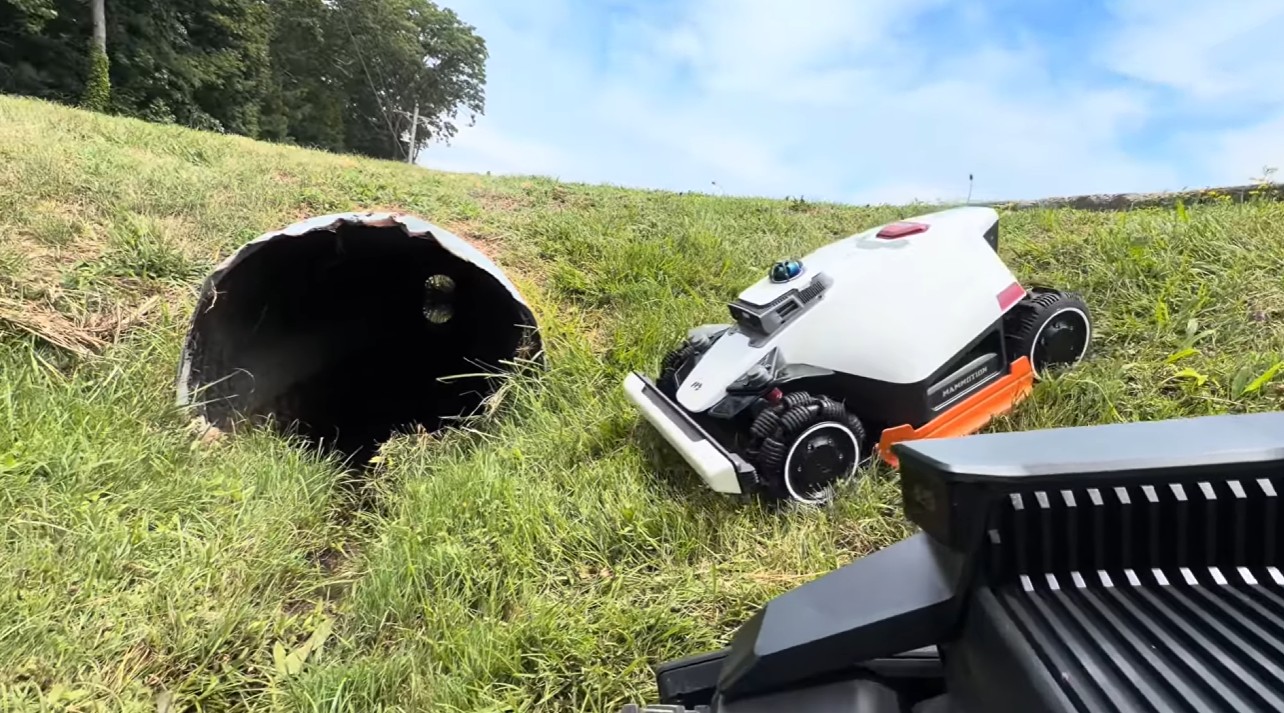
- Mammotion LUBA 3 AWD — 80% grade, about 39°, with LiDAR that keeps it located under tree cover where RTK drops out.
- Yarbo (tracked) — about 70%, and it handles rough ground beyond grass.
Ratings assume dry grass and a straight climb, so plan a real yard a notch below the sticker, and buy for the steepest section, not the average. Our best robot mowers for hills and slopes field test shows where each one gives up, and the 12 tips for hilly yards cover the setup habits — cutting height, dry-window scheduling, dock placement — that keep a slope machine on its feet.
Is your “impossible” property actually robot-mower ready?
Steep slopes, obstacle courses and big acreage are exactly where a professionally installed robotic mower makes the most sense — and exactly where a DIY setup is most likely to go wrong. The difference between a mower that transforms your weekends and one that ends up stuck against a tree is product selection, RTK setup, and mapping done right.

Zippy Lawnz is an authorized dealer and service center for Segway Navimow, Mammotion and Yarbo, serving Pennsylvania, New Jersey, Maryland, Delaware, Virginia and Colorado with hands-on installs, and everywhere else with nationwide sales and remote support. We handle everything: matching the right mower to your terrain, professional RTK and mapping setup, training, warranty service and ongoing support. In Bucks County, we come out from our West Chester store.
Have a hill you think no robot can handle? We’d love to prove you wrong.
- Map your lawn free (slope, size and sky view in about two minutes): app.zippylawnz.us
- Call or text: 410-725-7500
- Email: [email protected]
Frequently asked
Can a robot mower handle a 40% slope?
Yes — with the right machine. A 40% grade (about 22°) is beyond most entry-level robot mowers, which are rated for 30–45%, but it sits comfortably inside the all-wheel-drive class: the Segway Navimow X4 series is rated for 84% (40°) and the Mammotion LUBA 3 AWD for 80%. On this Bucks County install a Navimow X430 climbs, descends and side-hills a man-made berm whose steepest faces pass 40%. The honest caveat: every slope rating assumes traction, so wet grass, thin turf and whatever sits at the bottom of the hill still get assessed zone by zone before we map it.
How steep can the Segway Navimow X430 mow?
It's rated for slopes up to 84% grade — roughly a 40° incline — with four-wheel drive, Xero-Turn steering that pivots without dragging its wheels across the turf, and 2.8 inches of obstacle clearance. That's why a 40%+ berm is a real-world job for it rather than a stunt. The rating is a dry-grass, straight-climb number: on a real hill we plan a notch below it and keep safe margins anywhere a slide would end somewhere bad, like a road.
Do robot mowers work on a lawn with lots of trees and bushes?
They do, and it's mostly a mapping job. Each tree or shrub becomes a no-go zone the mower steers around, and the grass between them gets covered on the mower's normal pattern. On this berm there are dozens of newly planted trees and shrubs on the slope itself, so we mapped the property as several zones with connecting channels instead of one giant map — coverage improves, the schedule gets smarter, and the mower never has to figure out an obstacle course and a hill in the same breath. RTK is what keeps it precise enough to thread the gaps without scalping mulch beds.
Why did this install use a local RTK base station instead of network corrections?
Because of what's on the property and what's next to it. RTK gives the mower centimeter-level positioning; network corrections work well on open lawns, but this berm has real elevation change, tree canopy, and a road on one side that the mower absolutely cannot wander toward. A local base station mounted with a clear sky view gives the mower its own rock-steady reference a few hundred feet away, independent of cell coverage. We ran the wiring with weather-protected cable management so the install looks as good as it works.
Do you install robot mowers in Bucks County, PA?
Yes — Doylestown, Newtown, Yardley, New Hope, Warrington, Langhorne and all of Bucks County, from our West Chester store. Zippy Lawnz is an authorized dealer and service center for Segway Navimow, Mammotion and Yarbo, with hands-on installs across Pennsylvania, New Jersey, Maryland, Delaware, Virginia and Colorado and nationwide sales and remote support. We handle the whole job: slope assessment, mower sizing, RTK setup, zone mapping, training, warranty service and ongoing support. Call or Text Us: 410-725-7500.
Keep reading
 Buying guideBest Robot Mower for Hills & Steep Slopes (2026 Field Test)We tested the two most capable slope machines head-to-head on real rough ground: Mammotion LUBA 3 AWD (80%) vs Navimow X4 (84%) — and which tears up your turf.
 How-toDo Robot Mowers Work on Slopes and Hills?Yes — modern all-wheel-drive robot mowers handle brutal slopes. We break down a field test where a robot climbs an 84% grade (40°) and clears 2-inch obstacles.
 How-toRobot Mower Tips for Hilly Yards: 12 Ways to Win on SlopesTwelve field-tested robot mower tips for hilly yards: cutting height, wet-grass scheduling, exclusion zones, dock placement and slope-proof mapping from a dealer.
Explore the system
The mowers and pages behind this topic — see them sized to your yard.