
Navimow Signal Enhancement Antenna: Do You Need a Second RTK Unit?

If your Segway Navimow mows the front yard perfectly but gets confused, stops, or reports positioning errors in the back corner of your property, you’re not dealing with a defective mower. You’re dealing with physics. The RTK antenna that came with your Navimow has a real-world limit, and once your mower crosses it, precise navigation falls apart. The fix is the Navimow Signal Enhancement Antenna — a second RTK unit that extends coverage to the parts of your lawn the primary antenna can’t reach.
We install these regularly for customers across Pennsylvania, New Jersey, Maryland, Delaware, and Virginia, so this post covers how to know whether you need one, where to mount it, and how we run the cable so the finished install looks like it was always part of the property. The full walkthrough — reading the signal states, choosing the mounting location, running the underground PVC — is in the six-and-a-half-minute video above.
How far does the primary RTK antenna actually reach?
Segway rates a single Navimow antenna at a 200-meter radius — about 656 feet — in a completely open area. That last part is the catch. Almost no residential property is a completely open area. Trees, rooflines, sheds, fences, and terrain all eat into that number, which is why we plan installs around a conservative 600 feet and expect less anywhere there’s heavy canopy. (We measured this on a real property in Paoli — the correction held to about 600 feet with clear line of sight, and dropped off fast in the trees.)
| Scenario | Usable range from one antenna |
|---|---|
| Spec sheet — completely open area | 200 m / ~656 ft |
| How we plan real installs | ~600 ft |
| Through heavy canopy or structures | Meaningfully less — test on site |
There’s a second requirement that surprises people: RTK positioning only works when the mower and the antenna can see the same satellites at the same time. Your mower can be well within 600 feet of the antenna and still lose its fix if a stand of mature trees or the house itself blocks the shared view of the sky. This is why a backyard separated from the antenna by the home, or a lawn strip down a long tree-lined driveway, causes trouble even on properties that don’t seem that large.
What do the blue and yellow signal states mean?
The fastest way to diagnose a coverage problem is to watch the signal indicator while your mower works the trouble spot. Blue means the mower has a full RTK fix — it knows its position down to centimeters and will mow clean, straight lines. When the indicator turns yellow, the mower has degraded to a weaker positioning state. It may keep working for a bit, but you’ll see wavering lines, hesitation, and eventually a stop with a positioning error.
If the yellow always shows up in the same zones — the far backyard, behind the garage, the lawn along the drive — that’s not random interference. That’s the edge of your primary antenna’s usable coverage, and no amount of remapping will move it. A second antenna will.
(If the problem is dropped connections rather than yellowed positioning — “lost connection” alerts, pauses mid-job on a property with weak cellular — that’s the mower’s data link, not RTK range, and the fix is networking gear, not a second antenna.)
One prerequisite before you buy anything: this antenna — and the booster — only matter if the mower is actually running Local RTK. Out of the box, a Navimow defaults to NetRTK over the internet, and on that mode a same-spot dropout is a cellular dead zone, not a base-range problem. Two minutes confirming which mode you’re in saves buying the wrong fix.
What does the Signal Enhancement Antenna actually do?
The Signal Enhancement Antenna is not a simple repeater. It’s a second RTK reference unit that works alongside your primary antenna, and the two together create broader, more stable coverage than either could alone. Place it where the primary’s coverage runs out — the deep backyard, near the shed, on a post along a long driveway — and the mower maintains its centimeter-level fix across the whole property instead of dropping to yellow at the boundary.
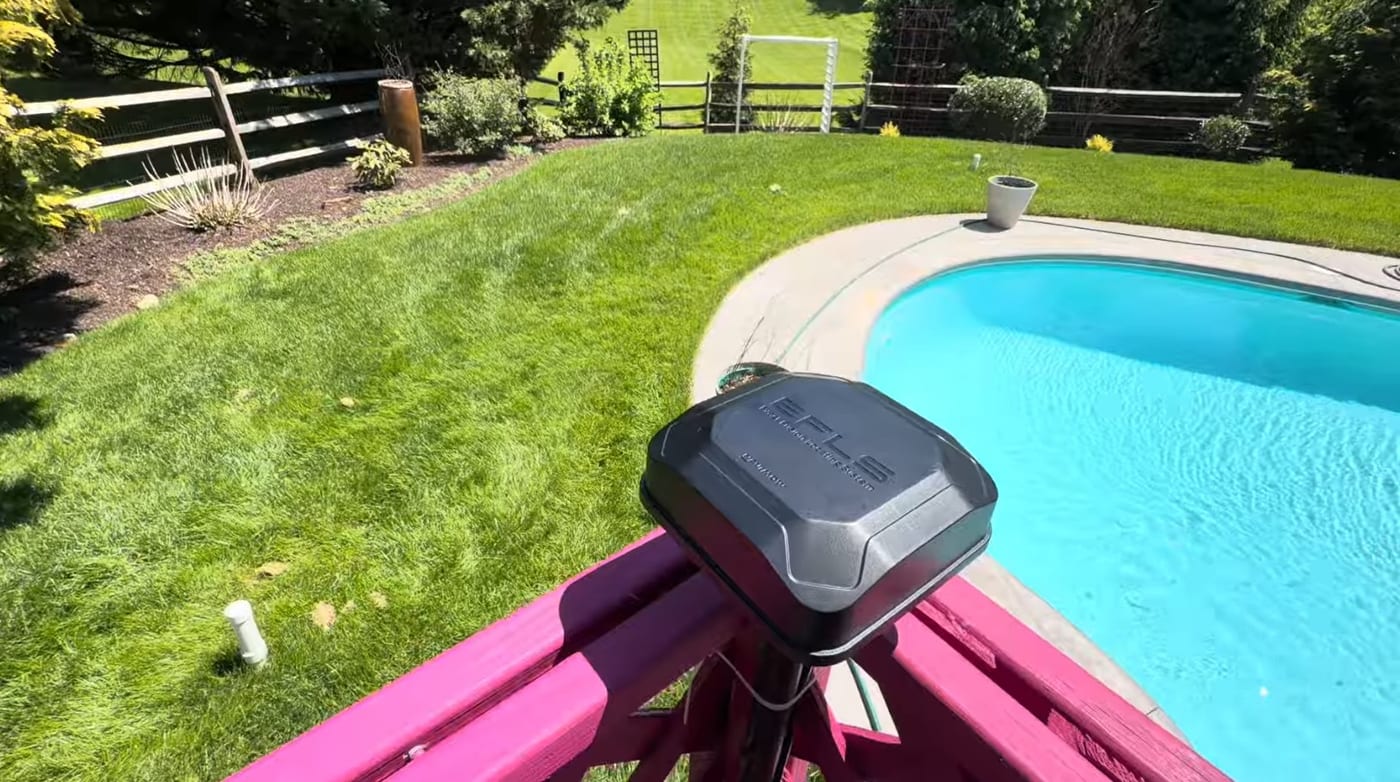
The kit ships ready to install: the antenna itself plus a rod, tube, pole, and base fork for ground mounting, a power supply adapter, and mounting hardware for attaching it to a wall, post, fence, or shed. The housing is weatherproof and built to live outside year-round, which matters here on the Mid-Atlantic coast where it will see everything from July humidity to a nor’easter. It fits the X3 series (X330, X350, X390), the X4 series (X430, X450), and the Terranox — not the i Series or H Series.
Where should the second antenna go?
Placement makes or breaks this install, and the rules are the same ones that govern the primary antenna. You want open sky above the unit — the more of the sky dome it can see, the better it shares satellites with your mower. Get it up high: a shed roofline, a fence post, or the included pole all beat ground level. Keep it clear of dense canopy, and position it so its coverage circle overlaps the primary’s. Two antennas whose zones overlap hand the mower a continuous fix; two isolated islands of coverage leave a dead band in between where the mower will still go yellow.
On a typical install we sketch the property first: primary antenna at the charging station on the patio, its 600-foot circle drawn over the lot, and the enhancement antenna placed to blanket whatever falls outside it. Ten minutes with a site map saves a return trip.
The part most people skip: burying the cable in PVC
The enhancement antenna needs power, and a cable draped across a lawn is both an eyesore and a future repair ticket — string trimmers, aerators, and dogs all find exposed wire eventually. On our installs we trench the run and sleeve the cable in PVC conduit the entire way. The pipe protects the wire from moisture and impact, and it means that if a cable ever does need replacing, you pull a new one through the existing conduit instead of digging up the yard again.

A shallow trench, PVC with glued joints, a gentle sweep fitting where the cable turns up the post or wall, and the turf folded back over the top — done right, a week of rain and one mowing later you can’t tell anything was ever buried.
Do you need one?
Here’s the honest dealer answer: most quarter-acre and half-acre suburban lots don’t. One well-placed primary antenna covers them fine. You’re a candidate for the Signal Enhancement Antenna if:
- Your mower shows yellow in the same areas repeatedly
- Your property pushes past roughly 600 feet from the antenna in any direction
- Heavy tree cover separates your front and back yards
- You’re mowing lawn along a long driveway far from the house
The antenna runs $249.99, which is a lot cheaper than the alternative people usually try first — moving the base station back and forth and remapping the whole property twice a season.
Get the signal picture right the first time
Coverage planning is exactly the kind of thing a professional installation settles before the mower ever ships: where the primary goes, whether the property needs a second unit, and where the conduit runs. Zippy Lawnz is an authorized dealer and service center for Segway Navimow, Mammotion, and Yarbo, with nationwide sales and remote support and hands-on installs across Pennsylvania, New Jersey, Maryland, Delaware, Virginia, and Colorado.
- 📍 Check my lawn — free — your lawn’s real size, tree cover and satellite sky view, measured in about two minutes.
- 🛒 Get the Signal Enhancement Antenna — $249.99 — fits the X3 and X4 series and Terranox; we’ll install it and bury the run in conduit.
- 🗺️ Book a free site assessment — we’ll pull up your address, draw the coverage circles, and quote the whole install.
- 📞 Call or Text Us: 410-725-7500
The fix: Navimow Signal Enhancement Antenna ($249.99) · a second RTK reference, not a repeater · plan ~600 ft per antenna, overlap the circles · mount it high with open sky · bury the power run in PVC conduit
Frequently asked
How far does a single Navimow RTK antenna reach?
Segway rates one antenna at a 200-meter radius — about 656 feet — in a completely open area. Almost no residential property is completely open, so we plan installs around a conservative 600 feet and expect less anywhere there's heavy canopy. There's a second requirement: the mower and the antenna have to see the same satellites at the same time, so a house or a stand of mature trees between them can break the fix well inside that radius.
What does it mean when my Navimow's signal indicator turns yellow?
Blue means a full RTK fix — the mower knows its position to centimeters and cuts clean, straight lines. Yellow means it has degraded to a weaker positioning state: wavering lines, hesitation, and eventually a stop with a positioning error. If the yellow shows up in the same zones every time — the far backyard, behind the garage, the lawn along the drive — that's the edge of your antenna's usable coverage, not random interference, and no amount of remapping will move it.
Does the Signal Enhancement Antenna help if my mower runs NetRTK?
No — this antenna extends the radio coverage of a local RTK base station, so it only matters if your mower is actually in Local RTK mode. On NetRTK (the factory default), corrections arrive over cellular or WiFi, and coverage gaps there are network problems: the fix is stronger cellular or WiFi over the lawn, not a second RTK unit. Worth checking which mode you're in before buying anything.
Is the Signal Enhancement Antenna just a signal repeater?
No — it's a second RTK reference unit that works alongside your primary antenna, and the two together create broader, more stable coverage than either could alone. Place it where the primary's coverage runs out and position it so the two coverage circles overlap: overlapping zones hand the mower a continuous fix, while two isolated islands leave a dead band between them where the mower still goes yellow.
Which Navimow models work with the Signal Enhancement Antenna?
The X3 series (X330, X350, X390), the X4 series (X430, X450), and the Terranox line. It is not compatible with the i Series or H Series. The kit runs $249.99 and ships install-ready — antenna, pole, base and power adapter — plus hardware for mounting to a wall, post, fence or shed.
Do I need a second RTK antenna for my robot mower?
Most quarter-acre and half-acre suburban lots don't — one well-placed primary antenna covers them fine. You're a candidate if your mower shows yellow in the same areas repeatedly, if your property pushes past roughly 600 feet from the antenna in any direction, if heavy tree cover separates your front and back yards, or if you're mowing lawn along a long driveway far from the house.
Keep reading
 Installation & SetupNetRTK vs Local RTK on a Navimow: Which Should You Run?Every Navimow runs one of two correction paths: NetRTK over the internet, or your own base station's direct radio link. How each works and when to switch.
 Installation & SetupWhere to Install Your Robot Mower's RTK Antenna (4 Rules)Mount your robot mower's RTK antenna wrong and it drifts after a season. The 4 rules of RTK placement — open sky, height, rigid mounting, and reflective surfaces.
 Customer InstallsHow Far Does Navimow RTK Reach Through Trees? A Paoli, PA InstallWe tested Navimow RTK range with clear line of sight and through trees, mounted a charging station on a brick patio with concrete anchors, and set up VisionFence.
Explore the system
The mowers and pages behind this topic — see them sized to your yard.