
How Far Does Navimow RTK Reach Through Trees? A Paoli, PA Install

Two questions come up on almost every robotic mower quote we write: “How far can the RTK antenna actually be from the mower?” and “What if I don’t have anywhere good to mount the charging station?”
On this installation in Paoli, Pennsylvania, we got to answer both — with a real range test on a real property, and a charging station anchored straight into a brick patio. The video above covers the whole thing in under eight minutes.
First, what does the RTK antenna actually do?
Before the range test makes sense, it’s worth being clear on the job the antenna is doing.
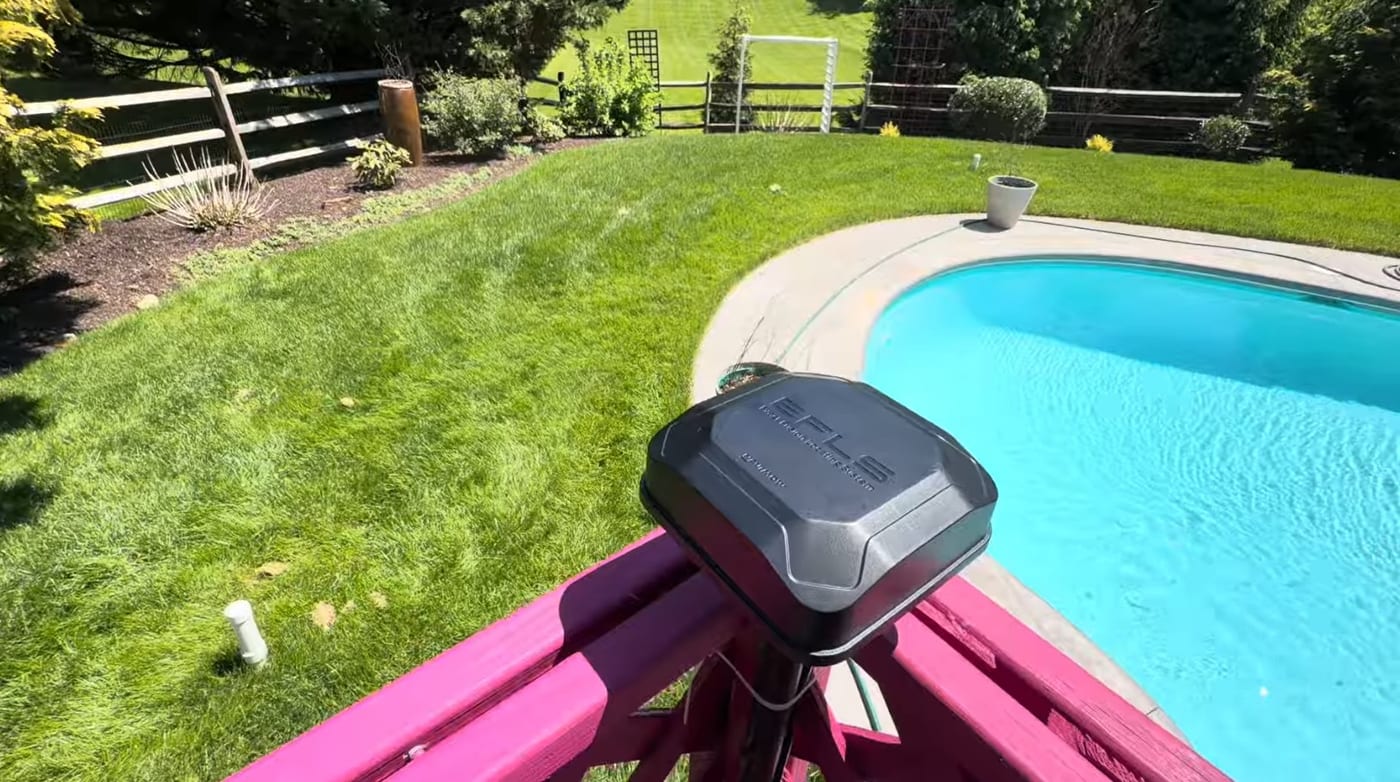
A Navimow doesn’t use a buried boundary wire. Instead, it uses RTK — Real-Time Kinematic positioning. The antenna sits in a fixed, known location with a clear view of the sky. It receives satellite signals, calculates the error in those signals, and broadcasts a correction to the mower. (That direct radio broadcast is one of two ways a Navimow can get its corrections — the other is NetRTK over the internet, the factory default.)
Standard GPS on its own is accurate to a few meters. That’s fine for driving directions and useless for mowing — a few meters of drift puts your mower in the flower bed. RTK correction pulls that down to centimeter-level accuracy, which is what lets the mower hold a clean edge along a driveway and mow in tidy parallel lines.
Two things follow from that:
- The antenna needs sky. Obstructions above it degrade the fix. (The four placement rules we follow on every install are here.)
- The mower needs to stay in radio range of the antenna. The correction signal has to actually reach the machine.
That second one is what we tested.

How far does the RTK signal reach with clear line of sight?
About 600 feet, in our test. We started with the best-case scenario — the antenna up at the gable peak and the mower moved progressively farther away with nothing in between — and the correction held the whole way out.
That’s the number that matches the spec-sheet framing, and on an open property it’s realistic. For scale: 600 feet of radius is well past the far corner of almost any residential lot. If your lawn is a wide-open parcel with the house in the middle, range is very unlikely to be your limiting factor. And if your property is the exception — mowing past 600 feet, or a lawn strip down a long drive — a second RTK antenna extends the coverage.
(Watch the 2:00 mark for the measured distances as we walk them.)
How far does it reach through trees and obstacles?
Then we walked it into the trees — and this is the part worth paying attention to, because almost nobody’s property is a wide-open field.
Radio signal doesn’t stop dead at an obstacle; it degrades. You can watch it happen in real time in the video: the mower’s LED tells the story — blue for a good signal, yellow when the correction drops out. What we found matches what we see in the field consistently:
- Trees cost you range, and wet foliage costs you more. Leaves and branches full of water absorb signal. A range test in March and the same test in July will not give you the same answer. Dense summer canopy is the worst case.
- Solid structures are worse than trees. A stone wall, a detached garage, or the house itself between the antenna and the mower cuts range much harder than vegetation does.
- Terrain matters as much as objects. A mower down in a dip behind a rise is effectively behind a wall, even with nothing planted in between.
- Height is the single biggest lever you control. Getting the antenna up on the roof rather than on a ground pole doesn’t just improve the sky view — it improves line of sight to the far corners of the property. That’s why we roof-mount whenever we reasonably can, from this gable peak in Paoli to the roof eave on our Carlisle septic-mound install.
The practical takeaway: the advertised range figure assumes clear line of sight. On a treed property, plan on meaningfully less — and plan on the worst case being midsummer with the canopy full in. (If your whole yard lives under canopy, start with our wooded-yards mower guide.)
And a property that fails on both fronts — trees hurting the base station’s sky view and cellular too thin to lean on — isn’t a dead end either. We’ve fixed exactly that with a WiFi extender on a backyard shed feeding the mower NetRTK corrections.
This is also exactly why we do a site evaluation before quoting a job. Two properties of identical size can have completely different requirements depending on what’s standing between the antenna and the back corner.
How do you mount a charging station on a brick patio?
Here’s the other problem this property presented: there was no lawn or wood surface where the charging station needed to go. The spot that made sense was brick patio.
This comes up more often than you’d think — patios, pavers, concrete pads, retaining walls. The included ground stakes are useless on hardscape, and “just set it down and hope” is not an installation.
What we used: concrete screws and anchors. The mount was anchored directly into the brick with concrete tap-in screws (Tapcon-style) and anchors. The process is straightforward if you do it properly:
- Position the mount and mark your holes. Measure twice here — you get one shot at hole placement in masonry.
- Drill with a masonry bit at the correct diameter. Match the bit to the fastener spec. Too big and the screw won’t bite; too small and you’ll snap it off in the hole.
- Drill into the brick body, not the mortar joint, where you can. Brick holds a fastener far better than mortar does.
- Clear the dust from the hole. This is the step people skip and it’s the one that causes pull-out. Masonry dust left in the hole keeps the threads from engaging properly. Blow it out.
- Drive the screws and check for movement. A finished mount should have zero play in any direction.
The result is permanent, level, and rock-solid — it isn’t going to shift when the mower docks into it a few hundred times a season, and it isn’t going anywhere over the winter.
One note on drilling into masonry: go in knowing where you’re drilling. Confirm nothing runs behind the surface, and understand that this is a permanent modification to the patio. That’s a conversation we have with the customer before the drill comes out, not after — the same way every step of a professional installation gets decided.
What is VisionFence for, if RTK is so accurate?
Even with a well-placed antenna, some areas of a property just don’t get reliable satellite coverage. Tight spots along the house, deeply shaded corners under mature trees, areas hemmed in by structures — that’s where a pure satellite boundary gets shaky.
That’s what VisionFence is for. It uses the mower’s onboard camera to visually recognize boundaries and obstacles, so the machine has a second source of truth that doesn’t depend on the sky.
We set it up on this install to lock in solid perimeters in the areas where satellite alone wasn’t going to cut it. The combination is what makes the system reliable: RTK does the heavy lifting for precision positioning across the open lawn, and VisionFence covers the corners where RTK gets thin.
If your property is heavily treed or tightly built, this isn’t an optional extra — it’s the difference between a mower you trust and one you keep going out to rescue.
Video chapters
- 00:00 — The Paoli install overview
- 00:45 — Roof-mounted RTK antenna setup
- 02:00 — RTK range test: clear line of sight
- 03:15 — RTK range test: through trees & obstacles
- 04:30 — Mounting on a brick patio (concrete anchors)
- 06:00 — VisionFence perimeter setup
- 07:15 — Final results & takeaways
Got a tricky property?
Not every lawn is a flat, open rectangle. Trees, hardscape, outbuildings, and odd layouts are exactly the situations where a professional install pays for itself — the difference between a robotic mower that quietly does its job and one that fights you all season.
Zippy Lawnz is an authorized dealer and service center for Segway Navimow, Mammotion, and Yarbo, with nationwide sales and remote support and hands-on installs across Pennsylvania, New Jersey, Maryland, Delaware, Virginia, and Colorado. We do on-site evaluations, professional installation, RTK and VisionFence setup, zone mapping, and ongoing service — serving Paoli and the Main Line, Chester County, and southeastern Pennsylvania.
- 📍 Check my lawn — free — your lawn’s real size, tree cover and satellite sky view, measured in about two minutes.
- 🗺️ Book a free site assessment — we’ll pull up your address, plan the antenna height and dock spot, and quote the whole install.
- 🤝 Your local Main Line dealer page — sales, install and service for Paoli, Malvern, Wayne, Devon and the Main Line.
- 📞 Call or Text Us: 410-725-7500
Installed: Segway Navimow + VisionFence · Location: Paoli, PA — the Main Line, Chester County · Range test: ~600 ft with clear line of sight, meaningfully less through trees · Setup: gable-peak RTK antenna, charging station anchored to brick patio with concrete screws
Frequently asked
How far can the Navimow RTK antenna be from the mower?
In our Paoli range test, the RTK correction held at roughly 600 feet with clear line of sight — considerably farther than most residential properties ever need. Through trees, structures, or terrain changes, expect meaningfully less, and expect the range to shrink further in midsummer when the foliage is full and wet. A site evaluation is the only way to know for sure on a given property.
Can I mount the RTK antenna on my roof?
Yes, and on most properties we recommend it. Height improves both the sky view and the line of sight to the far corners of the lawn — it's the single biggest range lever you control — and it keeps the pole and cable out of your yard. On this install the antenna went to the gable peak, the highest point the house offered.
Can the charging station go on a patio, pavers, or concrete?
Absolutely. On hardscape it gets anchored with concrete screws and anchors rather than the included ground stakes. Position the mount, drill with a properly sized masonry bit into the brick body rather than the mortar joint, clear the dust from the holes, and drive the screws until there's zero play. Done correctly, a hardscape mount is more secure than a ground installation.
What is VisionFence and do I need it?
VisionFence uses the mower's onboard camera to define boundaries and detect obstacles visually, independent of satellite signal. It's most valuable on properties with heavy tree cover, tight passages along the house, or deeply shaded corners where satellite coverage gets thin. RTK does the precision positioning across the open lawn; VisionFence covers the spots where the sky isn't enough.
Does tree cover mean a robotic mower won't work on my property?
Usually not. It means the installation needs more thought — antenna placement and height, possibly a different mount location, and VisionFence in the problem areas. We've put mowers on plenty of heavily treed properties. It just isn't a drop-and-go job, and it's exactly where a professional install earns its keep.
Does a Navimow work without the base antenna installed?
Yes — on NetRTK, the factory default, corrections arrive over the internet via cellular or WiFi instead of from a local base station, and many owners run that way without realizing it. The base antenna is the steadier option: a direct radio link with millisecond latency, no dependence on cell coverage, and the ~600-foot reach we measured on this install. On professional installs we pick the mode to match the property's cellular reality.
Do you install robot mowers in Paoli, PA?
Yes — Paoli, Malvern, Wayne, Devon, Berwyn, the whole Main Line and Chester County. Zippy Lawnz is an authorized dealer and service center for Segway Navimow, Mammotion and Yarbo, with nationwide sales and remote support and hands-on installs across Pennsylvania, New Jersey, Maryland, Delaware, Virginia and Colorado. We handle site evaluation, professional installation, RTK and VisionFence setup, zone mapping and ongoing service. Call or Text Us: 410-725-7500.
Keep reading
 Installation & SetupNetRTK vs Local RTK on a Navimow: Which Should You Run?Every Navimow runs one of two correction paths: NetRTK over the internet, or your own base station's direct radio link. How each works and when to switch.
 Installation & SetupWhere to Install Your Robot Mower's RTK Antenna (4 Rules)Mount your robot mower's RTK antenna wrong and it drifts after a season. The 4 rules of RTK placement — open sky, height, rigid mounting, and reflective surfaces.
 Installation & SetupNavimow Signal Enhancement Antenna: Do You Need a Second RTK Unit?Navimow mows the front fine but goes yellow out back? That's the edge of RTK range. When a second antenna is the fix, where to mount it, and what it costs.
Explore the system
The mowers and pages behind this topic — see them sized to your yard.