
How Many Satellites Does a Robot Mower Need?

Every RTK robot mower on the market steers by satellite. Not “GPS” in the phone-in-your-pocket sense — that’s accurate to a few metres, which would put your mower in the flower bed. These machines run RTK, and RTK is accurate to about an inch. The difference is worth understanding before you buy, because it’s the one part of a robot mower install that depends on your property rather than the product.
The short answer
A robot mower needs about 5 satellites shared between the rover and its base antenna to hold an RTK fix. A comfortable install sees 15 or more at every corner of the lawn.
Here’s the good news: most open properties in the continental US see 30 to 45 usable navigation satellites at any given moment. The raw count is almost never the problem. What matters is how many of them your specific yard can actually see — and that’s a question about your trees, your roof and your neighbour’s oak, not about the sky.
🛰️ See the satellites over your address right now — free, no account, nothing saved.
Why it takes two receivers
Plain GPS has an error budget: the signal bends as it crosses the ionosphere, the satellite’s clock drifts a hair, its published orbit is a touch off. Those errors add up to a few metres, and they’re almost identical for two receivers standing near each other.
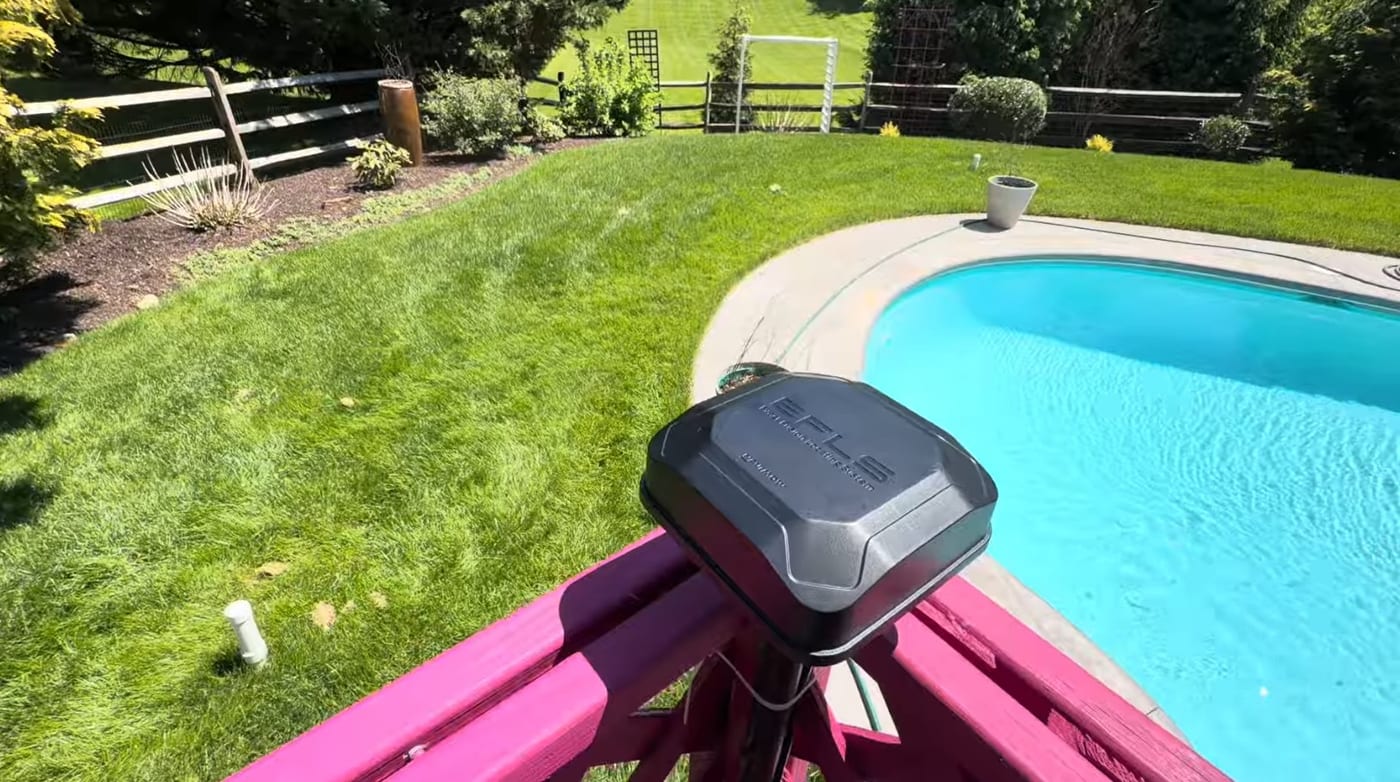
RTK exploits exactly that. You put a second antenna somewhere fixed — on your house, usually — and it knows precisely where it is. It watches the same satellites, measures how wrong they’re reading right now, and sends that correction to the mower continuously. The mower applies it and the shared error cancels out.
That’s the whole trick, and it’s why the sky matters twice: both receivers need the same satellites at the same time. A mower with a beautiful view of the sky and an antenna tucked under an eave is a mower with no fix.
What four constellations buys you
“GPS” is one system among several, and a modern mower tracks them all:
| Constellation | Operator | Roughly |
|---|---|---|
| GPS | United States | 31 satellites |
| GLONASS | Russia | 24 satellites |
| Galileo | European Union | 28 satellites |
| BeiDou | China | 35+ satellites |
Tracking four systems instead of one is why a mower can lose a dozen satellites behind a tree line and carry on knowing exactly where it is. It’s also why the honest answer to “will it work under my maple?” is usually, and we can check rather than a flat no.
The part trees actually take
This is the piece most buying guides skip. A canopy doesn’t dim the sky evenly — it eats the low satellites on that side, and the low ones are exactly the ones that square up the geometry of a fix. Receivers already ignore anything below about 10 degrees above the horizon, because that signal has crossed too much atmosphere and bounced off too much ground to trust.
So the count over your lawn can look healthy while one shaded edge still drifts. Tap the dial below to see what that does:
Two houses on the same street can behave completely differently for this reason, which is why we scan the tree line rather than guess from the address.
How the sky changes across a day
Navigation satellites orbit roughly twice a day, so the number over any fixed point rises and falls by ten or more across 24 hours. The dips are short, and a healthy install rides straight through them without you ever noticing.
It matters in one case: a marginal lawn. If your property is tight on sky to begin with, running the mow outside the daily low is a free improvement — no hardware, just a schedule change. Our Sky View tool plots the full 24-hour curve for your address so you can see your own low point instead of guessing at it.
When satellites aren’t the answer
Sometimes the sky genuinely isn’t there — a wooded lot, a narrow side yard between two houses, a north wall with a mature tree line. You have three honest options, and we’d rather say so up front:
- Move the antenna, not the mower. Height and an open aspect fix most of it. That’s the whole subject of where to install your RTK antenna.
- Switch the correction path. NetRTK pulls corrections over the internet instead of from an antenna on your house — nothing to mount, though it leans on a steady cellular signal at the lawn.
- Choose a mower that doesn’t rely on satellites alone. LiDAR and camera-vision machines keep navigating under a canopy where an RTK-only mower stalls.
Check your own sky first
You don’t have to take our word for any of this, and you don’t have to talk to anyone to find out. Type your address into the free Sky View tool and watch the live satellite picture over your property — every GPS, Galileo, GLONASS and BeiDou satellite currently above you, plotted by compass direction and height, with a slider for the next 24 hours. The math runs in your browser from public orbital data. Nothing is saved and no account is required.
🛰️ Open Sky View for my address →
When you’re ready for the other half of the answer — what your own trees and roof line block, which side of the house the antenna wants, and how far it reaches across your lawn — map your property and we’ll scan it from satellite surface data. That part is free too.
Frequently asked
How many satellites does a robot mower need?
A robot mower needs a minimum of about 5 shared satellites between the rover and its base antenna to hold an RTK fix, but a comfortable install sees 15 or more at every corner of the lawn. Most open properties in the continental US see 30 to 45 usable navigation satellites at any moment, so the number overhead is rarely the problem — what your trees and roof block is.
Which satellites do robot mowers use?
Modern RTK mowers track four constellations at once: GPS (United States), Galileo (Europe), GLONASS (Russia) and BeiDou (China), and some add QZSS over Japan. Tracking all four is why a mower can lose a dozen satellites behind a tree line and still know exactly where it is.
Why does my robot mower lose its signal under trees?
A canopy does not dim the sky evenly — it blocks the low satellites on that side first, and those are the ones that square up the fix. Receivers also ignore anything below about 10 degrees above the horizon because the signal travels through too much atmosphere and bounces off surfaces. So a yard can have plenty of satellites overhead and still lose its fix along one shaded edge.
What time of day is satellite coverage best?
Navigation satellites orbit roughly twice a day, so the count over any address rises and falls by ten or more across 24 hours. The dips are short and modern mowers ride through them, but if your lawn is marginal, scheduling mows outside the daily low is a free improvement. Our Sky View tool plots the whole 24-hour curve for your address.
Can I check the satellites over my house before I buy?
Yes, and free. Our Sky View tool takes your address and plots every navigation satellite over it right now, using public orbital data propagated in your browser. It costs nothing and needs no account.
Keep reading
 Installation & SetupWhere to Install Your Robot Mower's RTK Antenna (4 Rules)Mount your robot mower's RTK antenna wrong and it drifts after a season. The 4 rules of RTK placement — open sky, height, rigid mounting, and reflective surfaces.Installation & SetupNetRTK vs Local RTK on a Navimow: Which Should You Run?Every Navimow runs one of two correction paths: NetRTK over the internet, or your own base station's direct radio link. How each works and when to switch.
 Installation & SetupRobot Mower Losing Signal? The Shed WiFi Extender FixA Navimow X430 kept dropping connection — marginal RTK under heavy trees and one bar of cellular. Here's how a $160 outdoor WiFi extender on a shed fixed it.
Explore the system
The mowers and pages behind this topic — see them sized to your yard.