
Mammotion LUBA 4 AWD: Specs, Models and Release Date

Mammotion pulled the covers off the LUBA 4 AWD at IFA in Berlin on 4 September 2026, and the headline is not the slope rating or the acreage. It is the edges.
Every robot mower owner has the same complaint, and it has nothing to do with whether the machine works. It works. It just leaves a strip of uncut grass along the beds, the fence and the patio, and you end up walking the perimeter with a string trimmer anyway. The LUBA 4 is Mammotion’s answer to that, and it arrives with a genuinely new sensor stack underneath it.
Here is what has actually been confirmed, what has not, and who each of the three models is for.
The three models, at a glance
| 3000F | 6000F | 12000F | |
|---|---|---|---|
| Max mowing area | 0.75 ac (3,000 m²) | 1.5 ac (6,000 m²) | 3 ac (12,000 m²) |
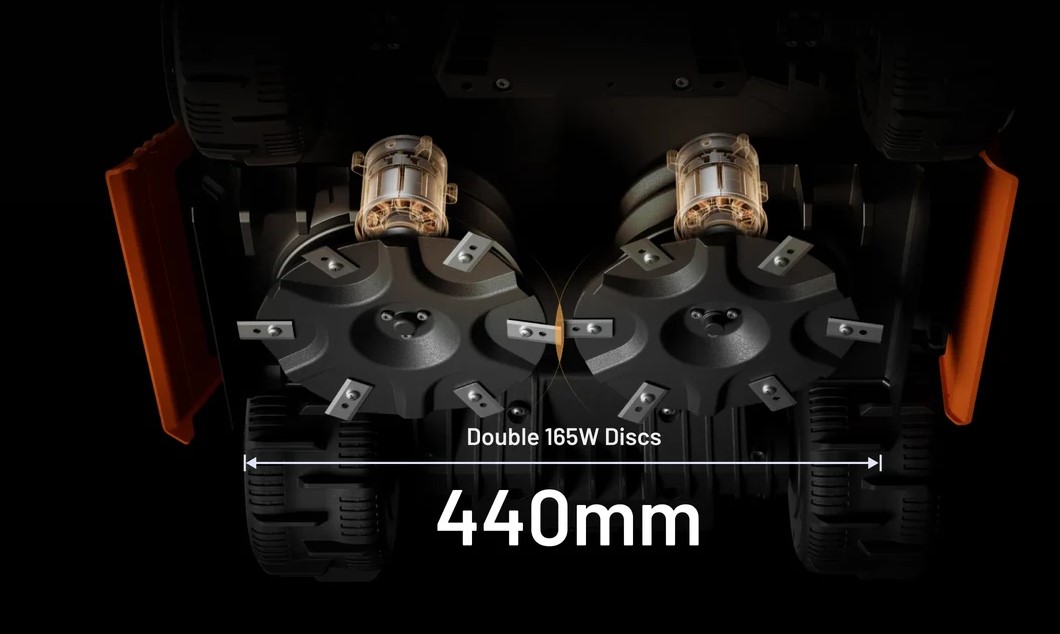
| Cutting discs | 2 × 165 W | 2 × 165 W | 3 × 165 W |
| Cutting width | 17.3″ (440 mm) | 17.3″ (440 mm) | 20.9″ (530 mm) |
| Cutting height | 1–3.9″ (25–100 mm) | 1–3.9″ (25–100 mm) | 1–3.3″ (25–85 mm) |
| Edge-trim module | Compatible | Compatible | Not compatible |
| Max slope | 80% (38.6°) | 80% (38.6°) | 80% (38.6°) |
| Obstacle crossing | 60 mm (2.4″) | 60 mm (2.4″) | 60 mm (2.4″) |
| Mowing speed | up to 1.0 m/s | up to 1.0 m/s | up to 1.0 m/s |
Every model gets six blades per disc, the same four-wheel drive, the same positioning stack and the same 210 W fast charger.
Two things in that table deserve more attention than they usually get. The first is the cutting-height range, which we will come back to, because it quietly fixes the most annoying purchase decision in the LUBA 3 lineup. The second is that the 12000F — the biggest, most expensive machine — is the one model that cannot take the edge trimmer. If the edge trimmer is why you are buying a LUBA 4, three acres does not make the 12000F the right answer.
What is actually new
Quad-vision: four cameras, not two
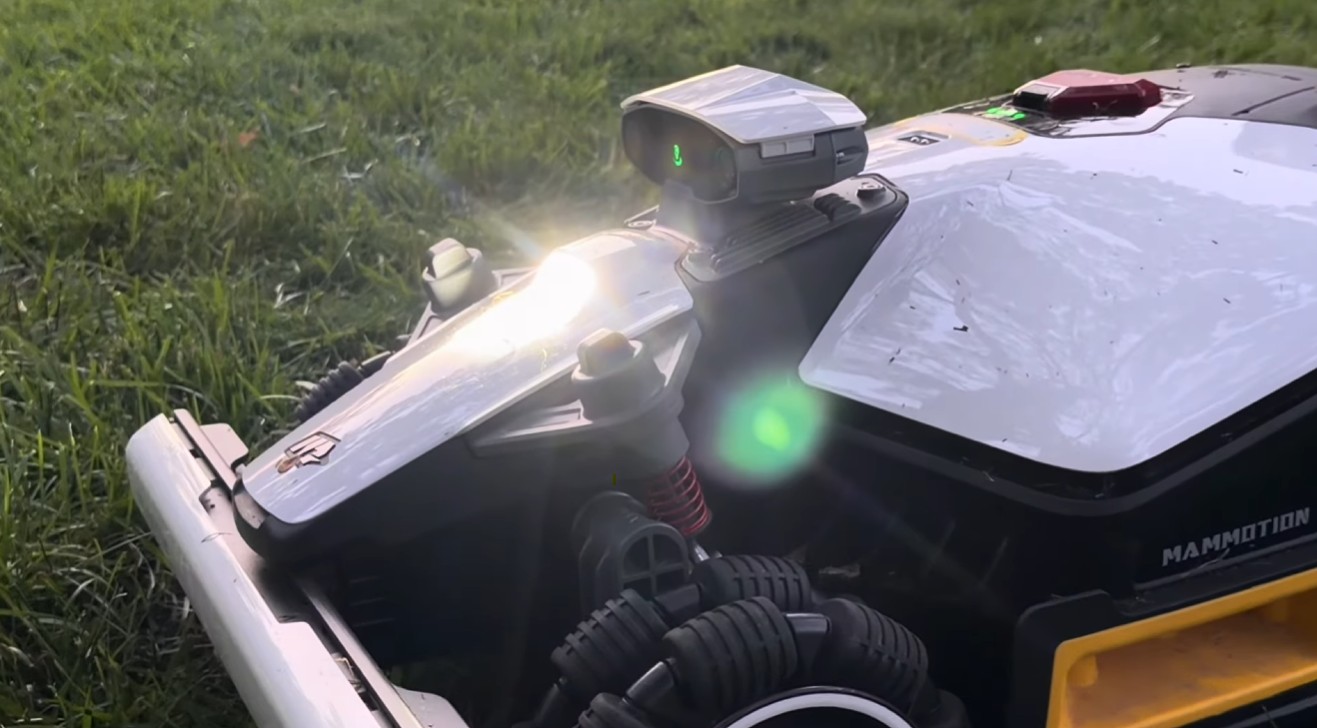
The LUBA 3 runs Mammotion’s Tri-Fusion positioning — 360° LiDAR, NetRTK and AI vision — and it is genuinely good. The LUBA 4 keeps all three layers and doubles the camera count to four wide-angle units covering front, sides and rear.
That matters for a specific, unglamorous reason: a robot mower does not usually get lost in the open. It gets lost in the pinch points — the gap between the garage and the fence, the shaded run under a row of spruces, the side yard where the house blocks half the sky. More cameras looking sideways is what keeps the machine confident in exactly those spots, and Mammotion’s claim is that the three layers now heal each other rather than simply voting. Lose satellites under canopy, and LiDAR plus vision carry the position until the sky opens back up.
Mammotion’s framing for this is “never starts a mow it can’t finish.” That is a marketing line, but it describes the right failure mode. The thing that annoys owners is not imperfect navigation; it is a mower that stops halfway and sends a notification.
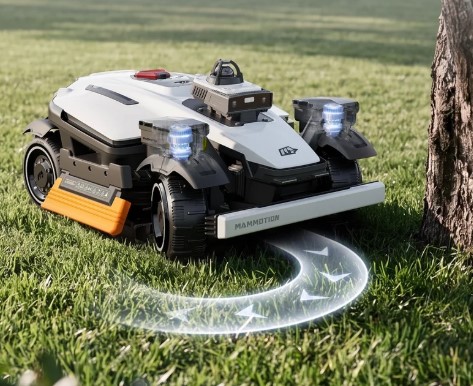
Independent front-wheel steering
Each front wheel gets its own steering motor, so the mower turns through a clean arc instead of dragging a wheel sideways through the turn.
If you have owned a robot mower for a season, you know why this is on the list. Skid-steering scrubs. Over a summer, the turn points at the end of each pass wear into visible rings and brown scuffs, and the tighter the zone, the worse it gets. Rolling the wheels through the turn instead of scrubbing them is the difference between a lawn that looks mowed and a lawn that looks driven on.
Bidirectional driving
Front and rear cameras plus that independent steering let the LUBA 4 reverse out of a dead end rather than executing a three-point turn on the spot.
Same underlying problem, different symptom: a pivot in a corner concentrates all the turning force on one patch of grass, and corners are where bald spots start. Backing out means no pivot pressure at all. On a lawn with lots of narrow returns — between raised beds, along a fence line, in a fenced dog run — this is the feature that will show up in the lawn itself by August.
The edge-trimming module
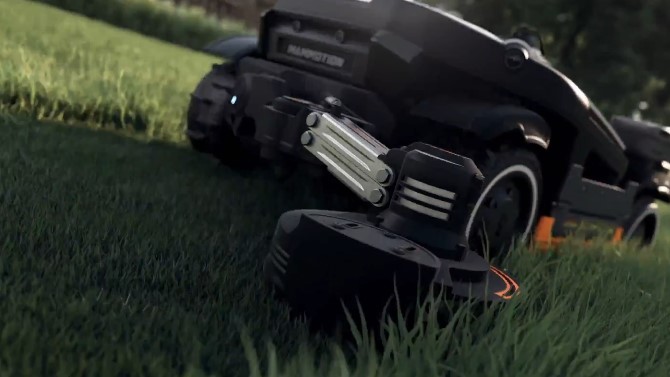
An add-on cutting module that works the boundary strip the main discs cannot reach.
This is the headline, and it is worth being precise about the caveats, because Mammotion is: it is an additional purchase, and it is not compatible with the 12000F. Pricing has not been announced. We also have not had one on a customer’s lawn yet, so we are not going to tell you how close it actually cuts to a stone wall — ask us again once we have run one through a season.
One cutting-height range instead of two decks
This one is not in Mammotion’s marketing, and it might be the most practical improvement in the whole machine.
Right now, buying a LUBA 3 means choosing between the S deck at 1″–2.7″ and the H deck at 2.2″–4″. You pick at purchase, you cannot change your mind, and if you guess wrong — you bought S and then decided you want to cut tall fescue at 3.5″ for summer heat tolerance — you own the wrong mower. We talk customers through that fork on nearly every LUBA 3 sale.
The LUBA 4 3000F and 6000F cover 1″–3.9″ in a single machine. The fork is gone. The 12000F tops out at 3.3″, which is still enough for most cool-season lawns but genuinely tight if you run fescue high.
What Mammotion has not published
We are a dealer, not a press-release repeater, so here is the honest ledger of what nobody knows yet:
- Battery capacity. No Ah figure, no Wh figure, for any of the three models.
- Runtime per charge. Not stated. This is the number that determines whether a 1.5-acre lawn actually finishes overnight, and it is missing.
- Charge time. The charger is confirmed at 210 W and the adaptive top-up behaviour is described, but no one has published minutes.
- Weight, dimensions and IP rating. Not stated. Do not assume it matches the LUBA 3.
- Warranty term and edge-trim module price. Not announced.
- Retail price. Not announced for any model.
If you find a site confidently listing LUBA 4 runtime or price today, they made it up. We will update this post as real numbers land.
The one thing to check before you order
The LUBA 4 uses NetRTK through Mammotion’s iNavi service — free for the life of the product, no base station, nothing to install on a pole in your yard. For most people that is a straight upgrade: the antenna mast is the ugliest part of a robot-mower install and the part most likely to need moving.
But correction data over a cellular network requires a cellular network. Mammotion’s own copy says “worldwide” with an asterisk pointing at a coverage checker, and the 100,000-household figure it cites is European. Rural properties in our service area — and plenty of wooded lots that are not rural at all — sit in spots where that is a real question rather than a formality.
This is the part we do for free, before you spend anything. Map your lawn on our site and we will tell you the measured grass area, the sky view, and whether there is a usable signal at the property — then tell you which model fits, or tell you honestly that a base-station mower is the safer call for your address.
Should you wait for it?
If your mower died last week and you need grass cut next spring, the LUBA 3 AWD ships now, shares the same Tri-Fusion positioning and the same 80% slope rating, and we install it the same week. The LUBA 4 is a Q4 2026 pre-order with no published price.
If you are shopping ahead and the things that bother you are edges, turn marks and corner wear, the LUBA 4 is aimed squarely at you and the wait is probably worth it.
We are an authorized Mammotion dealer and we will be taking LUBA 4 reservations as soon as Mammotion opens the order book. Reserve through us and you get the same thing every Zippy install gets: the property mapped, the signal verified on site, the zones and channels set up properly, the first mow run with you, and a phone number that a person answers afterward.
Keep reading
- LUBA 4 AWD vs LUBA 3 AWD — what actually changed, feature by feature
- LUBA 4 AWD 3000F, 6000F and 12000F — the individual model breakdowns
- LUBA 4 price and release date — what we know, updated as it lands
Frequently asked
When does the Mammotion LUBA 4 AWD come out?
Mammotion announced the LUBA 4 AWD at IFA in Berlin on 4 September 2026 and has said pre-orders open in Q4 2026. The company has not published a single global retail launch date, and model availability varies by region. If you need a mower for this coming season rather than next, the LUBA 3 AWD is shipping now.
How much does the LUBA 4 AWD cost?
Mammotion has not announced pricing for any of the three models. Anyone quoting you a LUBA 4 price today is guessing. For scale, the LUBA 3 AWD runs $1,799 for the 1500, $2,239 for the 3000 and $3,299 for the 5000, so the 3000F is the model that will sit closest to an existing price point.
What are the three LUBA 4 AWD models?
The 3000F covers up to 0.75 acres (3,000 m²), the 6000F up to 1.5 acres (6,000 m²), and the 12000F up to 3 acres (12,000 m²). The 3000F and 6000F share a twin-disc 17.3-inch deck; the 12000F adds a third disc for a 20.9-inch cutting path.
Does the LUBA 4 AWD need an RTK antenna installed in the yard?
No. The LUBA 4 uses Mammotion's iNavi NetRTK service, which delivers correction data over the cellular network instead of a base station on a pole. There is nothing to mount or aim. The trade-off is that it needs a usable cellular signal at the lawn — which is the one thing genuinely worth checking before you order.
How steep a slope can the LUBA 4 AWD handle?
Mammotion rates it at 80%, which is 38.6 degrees, using all-wheel drive with independent torque control at each wheel. That is the same headline slope rating as the LUBA 3 AWD. A slope rating always assumes traction, so wet grass, thin turf and what sits at the bottom of the hill still need assessing zone by zone.
Keep reading
 Robot Mower ComparisonsLUBA 4 AWD vs LUBA 3 AWD: What Actually ChangedA dealer's side-by-side of the LUBA 4 and LUBA 3 AWD: deck, cutting height, cameras, steering, edge trimming — and three reasons to buy the LUBA 3 anyway.Industry NewsLUBA 4 AWD Price and Release Date: What We KnowMammotion has not announced LUBA 4 pricing; pre-orders open Q4 2026. What's confirmed, what the LUBA 3 lineup suggests, and why nobody can quote a number yet.
 Industry NewsLUBA 3 Firmware Update: Cloud Mapping, DropMow & Live VideoMammotion's LUBA 3 firmware adds cloud mapping (10 saved lawns), DropMow no-map mowing, and live video. What each does, how to enable it, and who it's for.
Explore the system
The mowers and pages behind this topic — see them sized to your yard.