
LUBA 4 AWD 12000F: Three Acres on One Robot Mower
The 12000F is not a bigger 6000F. It is a different machine, and the differences run in both directions.
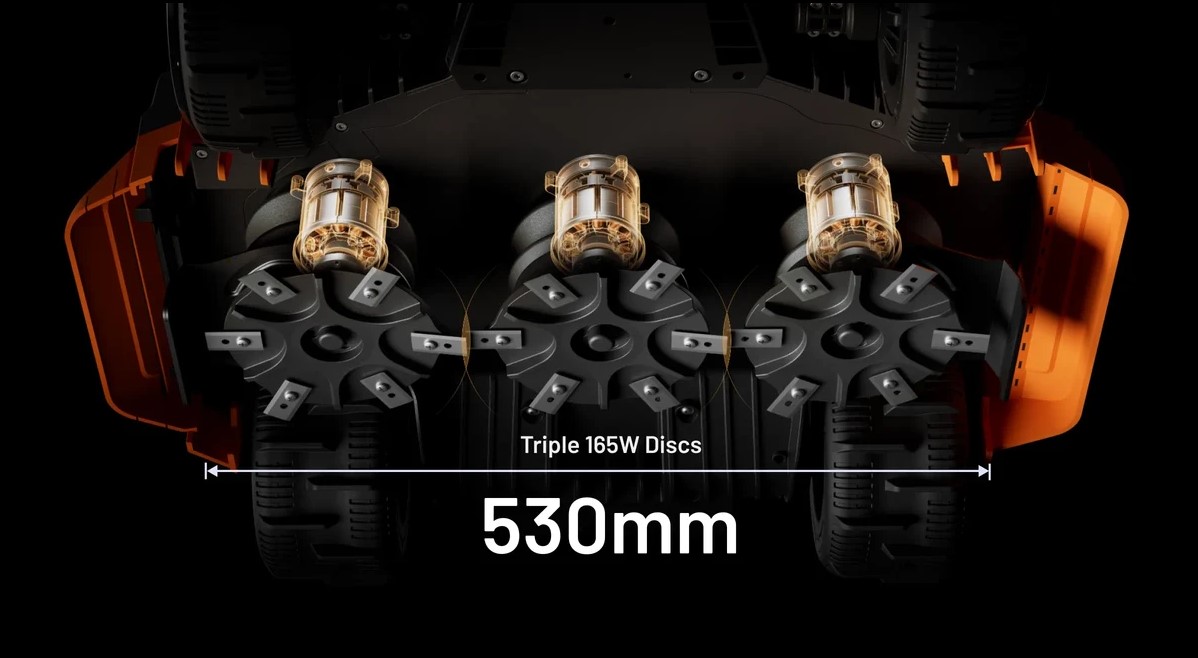
Rated for 12,000 m² — 3 acres, about 130,000 square feet — it carries a third cutting disc and a 20.9-inch cutting path, roughly a third wider than any LUBA 3 ever built. It also gives up two things its smaller siblings have, and one of them is the feature most of the LUBA 4 coverage has been about.
The specs
| LUBA 4 AWD 12000F | |
|---|---|
| Max mowing area | 3 ac (12,000 m²) |
| Cutting discs | 3 × 165 W, six blades each |
| Cutting width | 20.9″ (530 mm) |
| Cutting height | 1–3.3″ (25–85 mm) |
| Max slope | 80% (38.6°) |
| Obstacle crossing | 60 mm (2.4″) |
| Max speed | 1.0 m/s |
| Positioning | 360° LiDAR + NetRTK + 4-camera vision |
| Edge-trim module | Not compatible |
| Charger | 210 W fast charge, adaptive top-up |
The two trade-offs, stated plainly
No edge-trimming module
The edge trimmer is the headline feature of the entire LUBA 4 launch — the answer to the uncut strip along your beds and fence that every robot-mower owner still walks with a string trimmer. The 12000F cannot use it.
Mammotion does not explain why, but the likely reason is simply geometry: a third disc and a 20.9-inch deck occupy the space the module needs. Either way it is a hardware limitation, not something firmware fixes later.
This inverts the usual buying logic. Normally the largest model in a line is the most capable one. Here, the largest model is the only one missing the flagship feature. If automated edge trimming is why you are interested in the LUBA 4, the 6000F is the biggest model that delivers it — and a 2-acre customer should think carefully before assuming bigger is better.
A lower maximum cut height
The 3000F and 6000F cut from 1″ to 3.9″. The 12000F stops at 3.3″.
For most cool-season lawns at a normal cut, 3.3″ is fine. It matters if you deliberately run high — tall fescue at 3.5″ through July for heat and drought tolerance is standard practice, and the 12000F cannot reach it. On a 3-acre property, which is often exactly the kind of property running fescue, this is worth checking against how you actually manage your turf before you order.
Where the 12000F earns it
Real acreage on one machine. Three acres of maintained grass previously meant a commercial-class machine or multiple units. A 20.9-inch path at up to 1.0 m/s, with three 165 W disc motors driving six blades each, is built to cover ground rather than fuss over detail.
Thick growth. Three independently driven discs is meaningful torque. On a large property where the back acre gets cut less religiously than the front, a machine that does not bog in heavy grass is the one that keeps its schedule.
Serious terrain. The same 80% (38.6°) all-wheel-drive rating and 60 mm obstacle crossing as the rest of the line. Large properties tend to include the bank, the swale and the tree roots, and this machine is rated for all of it.
One dock, one app, one thing to maintain. Against two smaller mowers, a single machine is genuinely simpler to own — one dock to site, one map, one blade-change routine.
Where two smaller machines beat it
This comes up on nearly every large-property quote, and the deciding factor is shape, not size.
A single machine covering three acres spends real time driving between zones without cutting anything. That transit never appears in the acreage rating, and on a property split by a driveway, a treeline or a road, it can be a large fraction of the working day.
Two mowers, each with its own dock, cut simultaneously in their own areas with zero transit. On a genuinely divided property that often finishes faster than one big machine — and it gives you redundancy, which on a property this size is not nothing. If one is down for a blade change, the other keeps going.
We size this out for real on the properties we quote, and the answer genuinely goes both ways. A three-acre open field is a 12000F. Three acres in four separated parcels usually is not.
The unknowns hit hardest here
Every LUBA 4 caveat applies more sharply to the 12000F: no published battery capacity, runtime or charge time.
On 0.75 acres, missing runtime is a footnote. On three acres, it is the whole question. A machine covering 12,000 m² is running many mow-and-charge cycles every week, and the total elapsed time to finish the property is a direct function of numbers that do not currently exist in public.
The 210 W fast charger and adaptive top-up — where the mower calculates the remaining area and takes only enough charge to finish it — are clearly aimed at exactly this problem, and on a machine that recharges this often, that behaviour is worth more than it is on a small lawn. But nobody outside Mammotion can currently tell you how long a 12000F takes to mow three acres.
If you are considering this model, that is the specification to demand before you pay. We will publish it here the moment it is available.
What we would do first
Three acres is a property where getting the sizing wrong is expensive in both directions, and where a satellite guess is not good enough.
Map the property and we will give you the measured grass area, the zone layout, the sky view and the cellular signal — free. NetRTK matters more here than on a small lawn, because a three-acre property has far corners, and the far corner is where coverage falls off and where you will notice.
Then we will give you a straight recommendation: one 12000F, a 6000F if your measured acreage came back lower than you thought, or two machines if the shape of your property says so.
Keep reading
- Mammotion LUBA 4 AWD: full specs and release date
- LUBA 4 AWD 6000F — the largest model that takes the edge trimmer
- LUBA 4 vs Yarbo Pro — the other way to cover acreage
- Best robot mower for large lawns
Frequently asked
How big a lawn does the LUBA 4 AWD 12000F handle?
Mammotion rates it at 12,000 m², which is 3 acres or about 130,000 square feet of mowed grass. That is four times the 3000F and more than double anything in the LUBA 3 lineup.
Why can't the LUBA 4 12000F use the edge-trimming module?
Mammotion states the 12000F is not compatible, without giving a reason. The most likely explanation is geometry: the 12000F carries a third cutting disc and a wider 20.9-inch deck, which occupies the space the module needs. Whatever the cause, it is a hard limitation — not something a firmware update changes.
What is the cutting height range on the LUBA 4 12000F?
1 to 3.3 inches (25 to 85 mm). That is lower than the 3000F and 6000F, which reach 3.9 inches. If you run tall fescue high through summer heat, the 12000F cannot cut as high as its smaller siblings.
Is the 12000F better than buying two smaller robot mowers?
It depends on the property's shape, not its size. One machine is simpler to own and one dock to site. But on a property split into genuinely separate areas — separated by a driveway, a treeline or a road — two smaller mowers often finish faster and remove the transit time that a single machine spends driving between zones without cutting.
Keep reading
 Industry NewsMammotion LUBA 4 AWD: Specs, Models and Release DateEverything confirmed about the LUBA 4 AWD: 3000F, 6000F and 12000F specs, quad-camera vision, the edge-trimming module, and what Mammotion hasn't said yet.Buying GuidesLUBA 4 AWD 6000F: The 1.5-Acre Model ExplainedThe 6000F fills a gap the LUBA 3 never covered — 1.5 acres on one machine, edge-trimmer compatible. Why unpublished runtime matters most on this model.Robot Mower ComparisonsLUBA 4 AWD 12000F vs Yarbo Pro: Covering AcreageThree acres on wheels or six on tracks. A dealer for both compares the LUBA 4 12000F and Yarbo Lawn Mower Pro on coverage, terrain, price and what happens in winter.
Explore the system
The mowers and pages behind this topic — see them sized to your yard.