
The Mammotion Luba Kept Getting Stuck — So We Tried the Terranox

Two Mammotion Lubas kept getting stuck on this mountain. The Segway Navimow Terranox didn’t.
Some properties are easy. Flat suburban lawns, strong cell coverage, open sky — almost any modern robotic mower will do a great job. And then there are properties like this one.
Tucked into the Pine Creek Valley in Lycoming County — the Grand Canyon of Pennsylvania — this customer’s mountain log cabin sits on a large, steep, genuinely mountainous piece of land. The owners aren’t chasing golf-course stripes. They want the grass kept down consistently to reduce tick pressure around the home. That’s one of the most common (and most practical) reasons rural customers come to us: shorter grass means fewer ticks, and fewer ticks means the family and pets can actually enjoy the property.
The problem? This site had already defeated two robots.
Where the Mammotion Lubas struggled
The customer had been running two Mammotion Luba robots on the property. The Lubas are capable machines — we sell and service them, and on the right property they’re excellent. But on this terrain, they were getting stuck too frequently. Steep grades, uneven mountain ground, and challenging transitions meant the owner was regularly hiking out to rescue robots instead of enjoying hands-free mowing.
When a robot needs rescuing more often than it finishes a mowing job, the value proposition falls apart. It was time to try something purpose-built for this kind of ground.
Enter the Segway Navimow Terranox
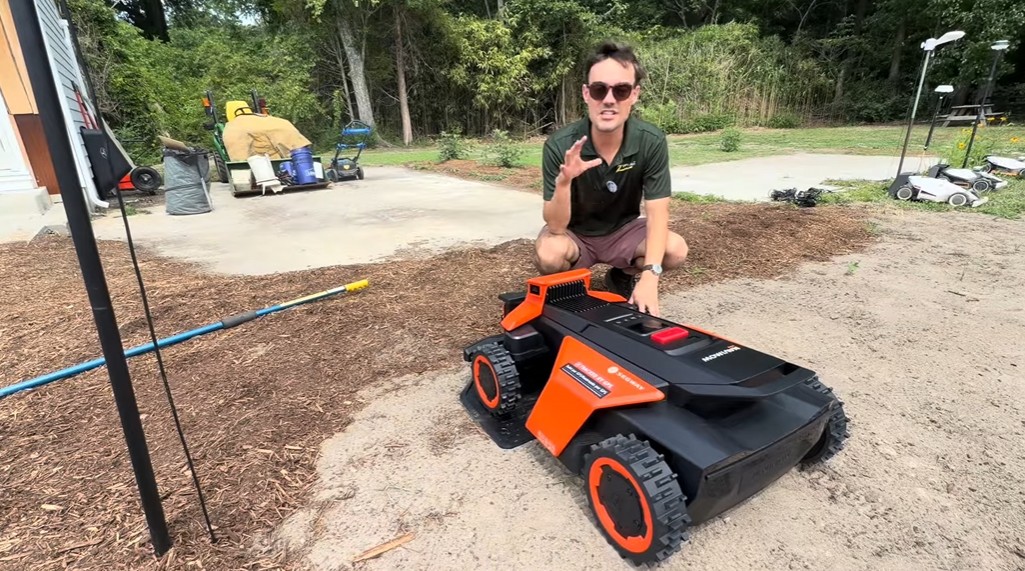
The Terranox is Segway Navimow’s new commercial-grade platform, and it’s built for exactly this scenario: all-wheel drive with heavy-duty suspension, a 17-inch cutting width, and rated slope capability up to 40 degrees (84%). That slope rating isn’t marketing fluff on a property like this — it’s the difference between a robot that works and a robot that becomes lawn art.
We deployed Terranox units on the property and put them through the same terrain that had been stopping the Lubas. The difference in how the Terranox carries itself on steep, broken ground is immediately visible: it holds traction, keeps its line, and powers through transitions that were trapping the previous robots.
The real challenge: terrible cellular coverage
Here’s the part of this install that makes it worth writing about.
This property has very poor cellular coverage — the kind of remote mountain location where your phone is basically a camera. That matters enormously for robotic mowers, because many modern wire-free robots depend on connectivity for their positioning.
RTK (Real-Time Kinematic) positioning is what lets these robots know where they are down to centimeter-level accuracy. Network RTK — where the robot receives correction data over a cellular connection — is wonderfully convenient when it works. On this mountain, it simply wasn’t an option. No reliable network, no Network RTK.
This is exactly the scenario where a robust local RTK setup earns its keep. With the correction source handled locally instead of depending on a cell network, the Terranox could maintain precise positioning in a location where connectivity-dependent systems would fail. If you own a remote property and you’re shopping for a robotic mower, this is the question to ask before anything else: how does this robot get its RTK corrections, and what happens when there’s no cell signal?
Reading the status lights
One of the things I demonstrate in the video is the Terranox status light system, because it’s a genuinely useful diagnostic tool for owners:
- Blue — everything is good. The robot has the positioning accuracy it needs and is operating normally.
- Yellow — satellite signals aren’t coming through properly. The robot is warning you that positioning quality has degraded, often due to tree cover, terrain shadowing, or interference.
- Red — the robot cannot operate. Positioning has been lost to the point where safe, accurate mowing isn’t possible.
On a wide-open lawn you may never see anything but blue. On a mountain property with tree lines and terrain blocking parts of the sky, watching how the lights behave as the robot moves through the property tells you a lot about your site — and about where a professional installation makes the difference between a robot that runs and one that constantly errors out.
Side by side on the same ground
We ran comparisons between the Terranox and the Mammotion robots on the same terrain, and the video at the top of this page shows everything working — the slopes, the status behavior, the recovery from tough spots. The takeaway isn’t that one brand is “better” than the other. It’s that matching the robot to the property is everything. The Luba is a great machine on the properties it was designed for. This property needed the Terranox.
That’s honestly the core of what we do at Zippy Lawnz. We’re an authorized dealer and service center for Segway Navimow, Mammotion, and Yarbo precisely so we can recommend the right robot for your site instead of forcing whatever we happen to sell.
Is your property a “hard” property?
If any of this sounds familiar — steep terrain, poor cell coverage, heavy tree cover, a robot that keeps getting stuck — your property probably needs a site evaluation before you spend money on (another) robot. We evaluate slope, sky visibility, connectivity, and terrain, and we’ll tell you honestly which platform will actually work.
- 📍 Check my lawn — free — your lawn’s real size, slope and satellite sky view, measured in about two minutes.
- 🗺️ Book a site evaluation — we’ll assess slope, sky, connectivity and terrain, and match the robot to the property.
- 📞 Call or Text Us: 410-725-7500 — authorized robotic mower sales, installation, and service for PA, NJ, MD, DE, VA, and CO.
Deployed: Segway Navimow Terranox · Location: Pine Creek Valley, Lycoming County, PA · Terrain: steep mountain ground, poor cell coverage · Previous robots: two Mammotion Lubas
Frequently asked
What robot mower works on steep mountain slopes?
The most capable slope machine we install is the Segway Navimow Terranox — a commercial platform with all-wheel drive, heavy-duty suspension and a rated slope capability up to 40° (84% grade). Consumer flagships like the Mammotion LUBA 3 (80%) and Navimow X4 (84%) are excellent on steep residential lawns, but on genuinely mountainous, broken ground it's the Terranox that holds traction and keeps its line. On this Pine Creek Valley property it worked terrain that had been sticking two Lubas. Slope rating isn't the whole answer, though — terrain roughness, sky view and connectivity matter just as much, which is why we evaluate the site before recommending a machine.
Do robotic mowers work without cell service?
Some do — if their RTK corrections are handled locally. RTK positioning is what gives wire-free robots centimeter-level accuracy, and many robots receive those corrections over a cellular connection (Network RTK). No reliable signal means no Network RTK. On a remote property the robot needs a local correction source on site instead of the cell network. That's the first question to ask before buying a robot mower for a remote property: how does this robot get its RTK corrections, and what happens when there's no cell signal? On this mountain install, a robust local RTK setup is what let the Terranox hold precise positioning where connectivity-dependent systems would fail.
Why does a Mammotion Luba keep getting stuck?
Usually because the terrain is beyond what the machine was designed for: grades at or past its slope rating, uneven broken ground, and steep transitions between zones. The Luba is a genuinely capable robot on the properties it was built for — we sell and service them — but when you're rescuing a robot more often than it finishes a mowing job, the fix isn't another rescue hike. It's matching the platform to the property. A site evaluation of slope, sky view, connectivity and terrain tells you which robot will actually run.
What do the Navimow Terranox status lights mean?
Blue means everything is good — the robot has the positioning accuracy it needs and is operating normally. Yellow means satellite signals aren't coming through properly — positioning quality has degraded, often from tree cover, terrain shadowing or interference. Red means the robot cannot operate — positioning has been lost to the point where safe, accurate mowing isn't possible. On a mountain property, watching how the lights behave as the robot moves tells you a lot about your site's sky view.
Do you install robot mowers on rural or mountain properties in Pennsylvania?
Yes — this install is in the Pine Creek Valley in Lycoming County, and we handle rural and mountain properties across Pennsylvania, New Jersey, Maryland, Delaware, Virginia and Colorado, with nationwide sales and remote support. Steep ground, poor cell coverage and tick pressure are exactly the jobs we specialize in: we evaluate slope, sky visibility, connectivity and terrain, then tell you honestly which platform will work. Call or Text Us: 410-725-7500.
Keep reading
 Commercial & Sports FieldsSegway Navimow Terranox Review: 3-Acre vs 6-Acre Commercial MowerHands-on Navimow Terranox review from an authorized dealer — the 3-acre CM120M1 & 6-acre CM240M1 commercial robot mowers: setup, mapping & verdict.
 Customer InstallsNavimow Terranox vs. Parked Cars: A 3-Acre Install in Chester, MDA Segway Navimow Terranox on a 3-acre Chester, MD lawn: why oversizing is the right call, a 33% blade upgrade for thick turf — and mowing around parked cars.
 Customer InstallsNavimow X430 vs. Maryland's Steepest Lawn: Annapolis InstallThe steepest lawn we've ever installed on: gas crews tore up this hilly Annapolis, MD property for years. How an AWD Navimow X430 made it 100% autonomous.
Explore the system
The mowers and pages behind this topic — see them sized to your yard.