
Robot Mower Not Cutting Evenly? 7 Fixes for a Crisper Lawn
The mower runs every day. The app says everything’s fine. And the lawn still doesn’t look… crisp. Brown-tipped a few days after cutting, a straggler standing here and there, maybe a strip that never quite gets done.
We service robot mowers for a living, and nearly every “it’s not cutting right” call comes down to one of seven causes. Here they are in the order we actually find them — most are ten-minute fixes, and two of them are free.
The quick diagnostic
| What you’re seeing | Most likely cause | The fix |
|---|---|---|
| Lawn turns brown/gray a few days after mowing | Dull blades tearing instead of slicing | Replace blades, new screws |
| Clumps of clippings, ragged cut | Packed deck and/or mowing wet grass | Clean the deck, shift the schedule |
| Scattered stragglers and leaning grass that survives passes | Grass slipping between blades | Run 9 blades per disc |
| Scalped high spots next to shaggy low spots | Cutting height too low for the ground | Raise a notch or two, step back down |
| One thin uncut line on every pass | A blade that’s stuck, bent, or missing | Spin test — every blade must swing |
| Visible lines between cut and uncut | Mowing too infrequently | Daily or every-other-day schedule |
| Same missed strip at the same edge, every time | Positioning drift — not the blades at all | Fix the RTK antenna placement |
1. Are your blades just dull?
This is the #1 cause, and the easiest to rule out. Sharp blades slice; dull blades tear. A torn grass tip frays, loses moisture, and browns — which is why a lawn cut with tired blades looks fine on mowing day and slightly dead three days later. Torn tissue is also an open door for fungal disease.
The test costs nothing: look at the grass tips, not the blade. Clean, flat tips mean sharp. Frayed, whitish-brown tips mean the blades are done, whatever the calendar says. Replace them every 4–6 weeks with daily mowing — with the new screws from the kit, every time. The screw, not the blade, is the part that actually fails.
2. When did you last clean the deck?
A packed deck ruins the cut before the blades even get a vote. Wet clippings compact under the deck, the discs drag through a wall of packed grass instead of spinning freely, and a dragging blade tears rather than cuts. It also eats battery runtime.
It’s a five-minute fix: cleaning mode, then blow the deck out with an air brush or compressed air. Here’s the full routine — every week or two during growing season. And never, ever with a pressure washer; that’s the fastest way to kill a robot mower.
3. Is the mower cutting wet grass?
Check what time your mower runs. Overnight and dawn schedules put the mower into the heaviest dew of the day. Wet grass clumps, mats down under the mower, and tears instead of slicing — and cutting soaked grass raises the disease risk on every fresh wound.
Shift the schedule toward late morning through afternoon, when the lawn is driest, and a surprising amount of “cut quality” trouble disappears without touching the hardware. More on the trade-offs in our scheduling guide and the honest look at night mowing and dew.
4. Does your grass lie down instead of standing up?
Some grass doesn’t cooperate. Bermuda and other warm-season types cut low, grass that leans after wind or rain, thin-stemmed weeds — all of it can slip between the blades on a standard disc and pop back up behind the mower as stragglers.
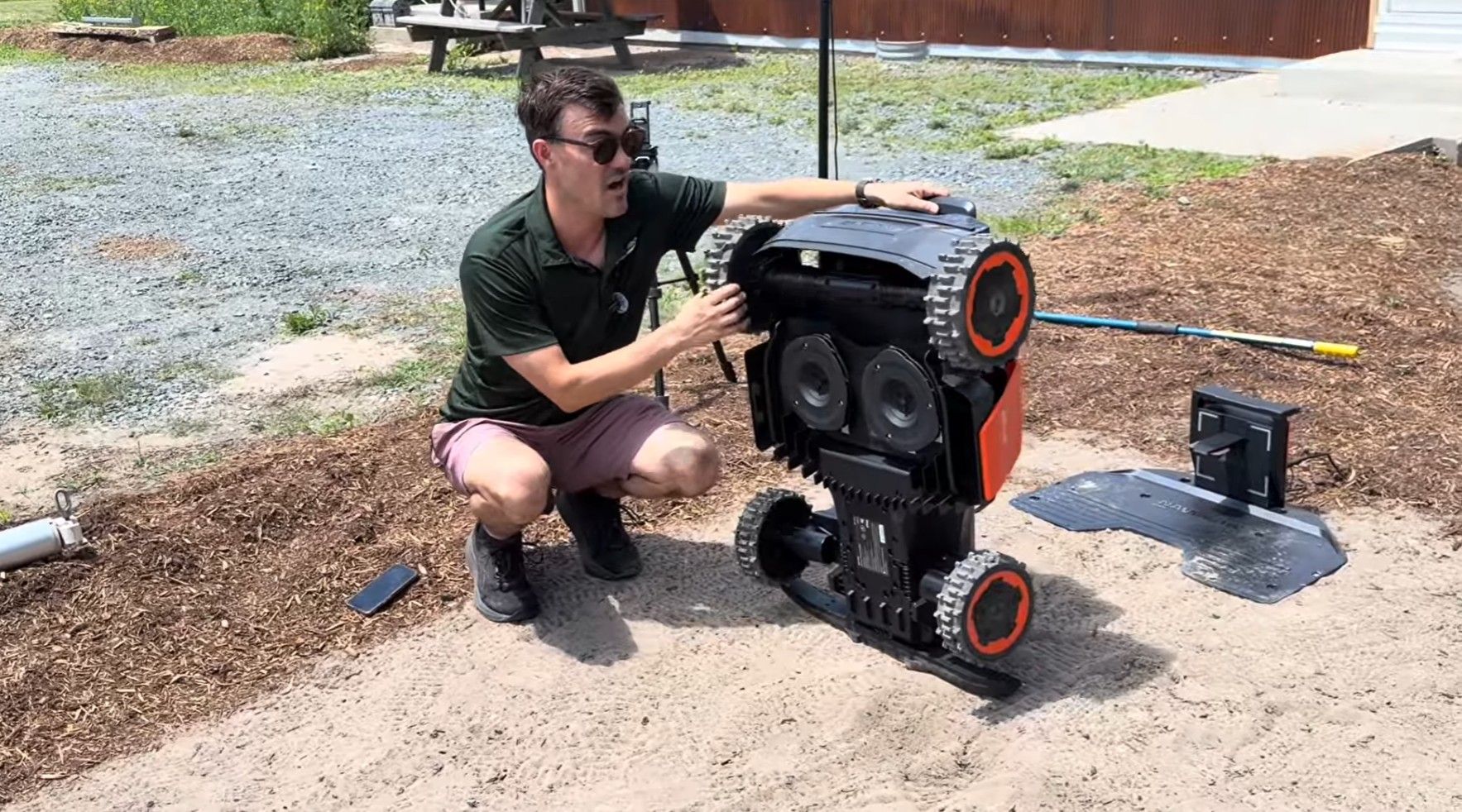
The fix we run on our own demo units: more cutting edge. A Navimow’s discs are factory-drilled for 9 blades each, but ship with 6 — filling the three hidden slots per disc gives you 18 blades total, 50% more edge, and it costs about one OEM blade pack and fifteen minutes.
5. Is the cutting height fighting your ground?
On uneven ground, a low setting scalps the high spots — and a scalped patch next to a shaggy dip is exactly what “uneven cut” looks like, even though the mower is doing precisely what it was told.
Remember that a robot mower’s height setting isn’t a per-mow choice like a push mower — it’s the height your lawn lives at permanently. Set it a notch or two higher than your target, watch a few cycles, then step down to the lowest setting that doesn’t scalp anywhere. (If you’ve just added blades, start higher still — more edge removes material faster.)
6. Is one blade stuck, bent, or missing?
A single bad blade cuts a repeating gap. Navimow-style blades must pivot freely on their screws; a blade that’s bent from an impact, seized on a worn screw, or simply gone leaves a thin uncut line on every rotation.
Thirty-second check: power off, spin each disc by hand, and flick every blade. Each one should swing freely. Any blade that doesn’t — or any screw with visible wear at the shoulder — gets replaced. New screws, snug not tight, and make them swing.
7. Is it actually mowing often enough?
A robot mower on a twice-a-week schedule is doing a bad impression of a push mower. The entire design is little-and-often: shave a small amount daily, let the fine clippings mulch back invisibly, and the lawn never has a “just mowed” vs “needs mowing” state. That daily rhythm is also what grows the dense, even turf these machines are known for.
If you dialed the schedule back to save the machine, don’t — the mower is happiest working small amounts daily, and so is the lawn.
What if it’s missing whole strips at the edges?
Then stop looking at the blades — that’s a positioning problem. A mower that consistently misses the same strip along a bed or fence line is drifting off its map, which usually traces to a marginal RTK antenna spot: too low, wobbling, or seeing too little sky. That failure is slow and silent, so it reads like a mowing problem when it’s really an antenna placement problem — or, on tough properties, a signal problem with a networking fix.
Get help with your robot mower
Zippy Lawnz is an authorized dealer and service center for Segway Navimow, Mammotion, and Yarbo, with nationwide sales and remote support and hands-on service across Pennsylvania, New Jersey, Maryland, Delaware, Virginia, and Colorado. If you’ve worked the list and the cut still isn’t right, that’s what we’re for.
- 📍 Check my lawn — free — your lawn’s real size, slope and satellite sky view, measured in about two minutes.
- 🗺️ Book a free site assessment — we’ll pull up your address, plan the antenna and dock, and quote the whole install.
- 📞 Call or Text Us: 410-725-7500
The list: blades (4–6 weeks, new screws) · clean deck · dry-window schedule · enough blades for your grass · height above the scalp line · every blade swinging · daily cadence — and if it’s the same strip every time, it’s the antenna, not the mower
Frequently asked
Why does my lawn look brown a few days after the robot mower runs?
Dull blades. Sharp blades slice grass cleanly and the lawn stays uniformly green; dull blades tear it, the torn tips fray and dry out, and within a couple of days the whole lawn takes on a brownish-gray cast. It also opens the door to fungal disease. Replace the blades — every 4–6 weeks with daily mowing, always with the new screws from the kit — and the color comes back with the next cycle of growth.
Why is my robot mower leaving patches of uncut grass?
It depends where the patches are. Scattered stragglers — a leaning stalk here, a thin weed there — mean grass is slipping between the blades: dull edges, a packed deck, or simply not enough blades on the disc (a Navimow can run 9 per disc instead of 6 using its factory holes). Missed strips along the same edges every time are a different problem entirely: that's positioning, usually RTK drift from a marginal antenna spot, not the cutting system.
What cutting height should a robot mower be set to?
Higher than you think, at least to start. Robot mowers cut a tiny amount daily, so the height you set is the height your lawn lives at permanently — and on uneven ground a low setting scalps the high spots, which reads as an uneven, patchy cut. Set it a notch or two above your target, let a few cycles run, then step down until you find the lowest setting that doesn't scalp anywhere.
How often should a robot mower actually mow?
Daily or every other day for most lawns. The whole design is little-and-often: shaving a small amount each day produces the dense, even, always-mowed look, and the fine clippings disappear back into the turf as mulch. Running a robot mower twice a week makes it behave like a weekly push mow — longer clippings, more visible lines between cut and uncut, and more work per blade edge.
Keep reading
 Tips & MaintenanceNavimow Blade Replacement: How Often, How To, and TitaniumHow often to replace Segway Navimow blades (4–6 weeks daily mowing), the new-screws rule everyone breaks, and our honest take on titanium-coated blades.
 Tips & MaintenanceHow to Clean Your Navimow Robot Mower (Deck & Grass Clumps)Learn how to clean a Segway Navimow robot mower the right way — cleaning mode, an air brush for the deck, and why you should never use a pressure washer.
 Tips & MaintenanceCan You Add More Blades to a Segway Navimow? Yes — 18 of ThemEvery Segway Navimow ships with 12 blades — but the discs are drilled for 18. How to fill the three hidden slots on each disc for 50% more cutting edge.
Explore the system
The mowers and pages behind this topic — see them sized to your yard.